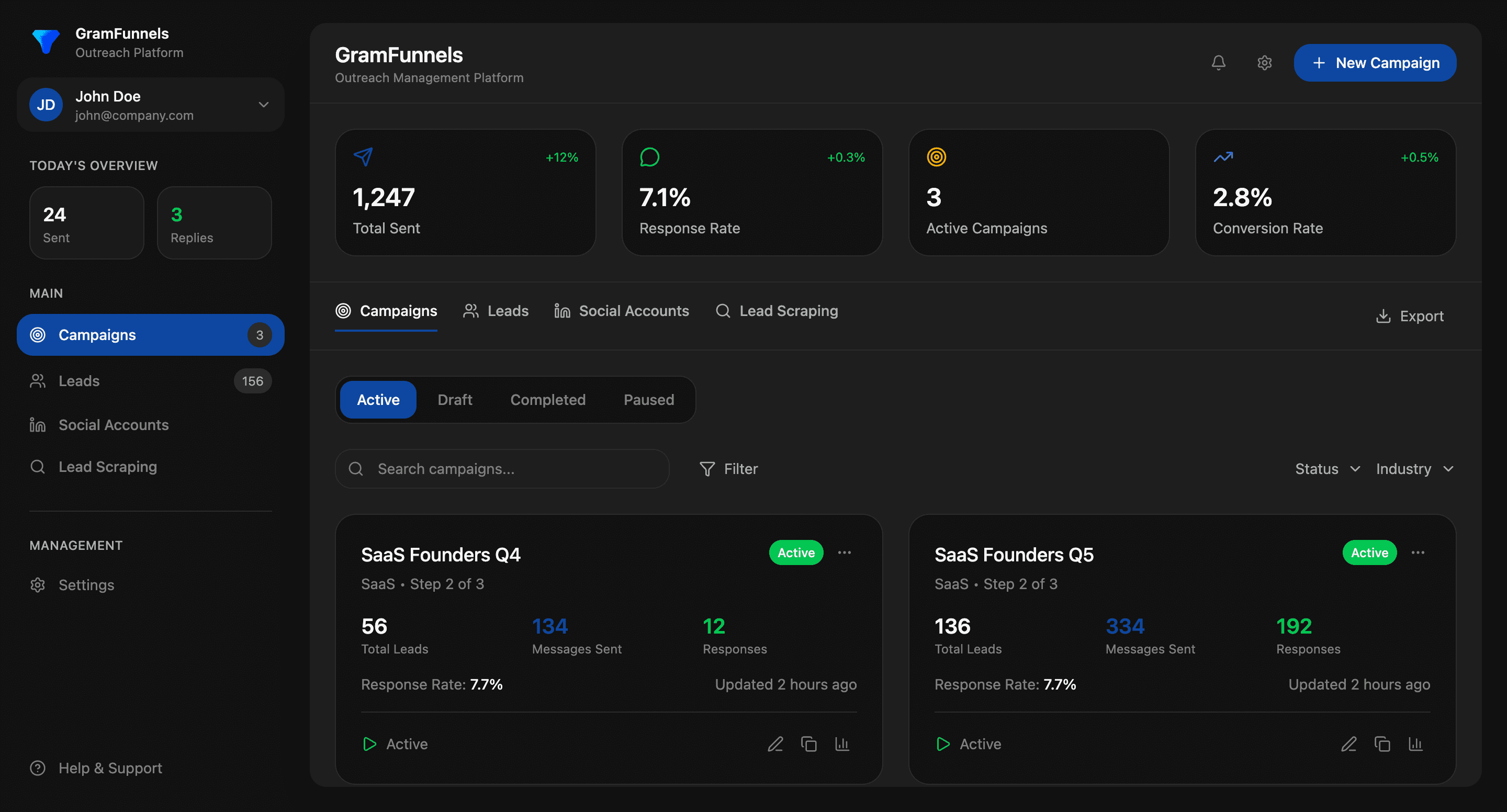
You're sending dozens of direct messages every week. Your team is working hard on outreach. But are you actually moving deals forward?
The problem isn't effort-it's measurement. Most sales teams focus on vanity metrics like message volume instead of outreach metrics that predict revenue. Without tracking the right KPIs, you're flying blind.
This guide reveals the essential outreach metrics you need to monitor, how to calculate them, and most importantly, how to use them to drive real sales results.
What Are Outreach Metrics and Why They Matter
Outreach metrics are quantifiable measurements that track the performance and effectiveness of your prospecting and sales engagement efforts. Unlike social media vanity metrics (likes, followers), outreach metrics focus on pipeline generation and revenue impact.
Consider this: A prospect who replies to your message is 10x more valuable than someone who doesn't-even if neither converts immediately. That reply indicates interest and creates a conversation opportunity.
According to HubSpot's 2024 Sales Benchmark Report, sales teams that track outreach performance systematically achieve 32% higher win rates compared to those relying on intuition alone. The reason? Data-driven refinement.
When you measure the right metrics, you can:
- Identify which messaging resonates with your audience
- Spot bottlenecks in your sales process
- Calculate true ROI on outreach campaigns
- Coach team members on what actually works
- Scale what's working and eliminate what isn't
Core Outreach Metrics to Track
Not all metrics are created equal. Here are the core outreach metrics that directly impact revenue:
1. Reply Rate
Your reply rate is the percentage of prospects who respond to your outreach.
Formula: (Number of Replies / Total Messages Sent) × 100
A typical reply rate ranges from 5-15% depending on your industry and approach. B2B outreach typically sees lower reply rates (5-10%), while B2C and niche markets often see 10-20%+.
Why it matters: A reply is a conversation starter. It indicates genuine interest and separates engaged prospects from uninterested ones. Improving reply rate is often the highest-impact metric you can optimize.
How to improve: Personalization is king. Generic messages get 2-3% reply rates. Personalized messages that reference specific details about the prospect's company or recent activity see 8-12% reply rates. Use tools like X DM automation that enable keyword-targeted outreach to reach more relevant prospects.
2. Conversion Rate
This measures the percentage of conversations that advance to the next stage of your sales pipeline (demo scheduled, meeting booked, proposal sent).
Formula: (Number of Sales Qualified Leads / Total Replies) × 100
Benchmark conversion rates range from 15-40%, depending on your offer and sales process. Enterprise SaaS typically converts at 25-35%, while SMB offers might see 40-50%.
Why it matters: A high reply rate means nothing if replies don't convert. This metric reveals whether your offer resonates and whether your follow-up approach moves deals forward.
How to improve: Train your team on consultative selling techniques. Ask qualifying questions early. Use high-converting DM copy frameworks that set clear next steps instead of vague CTAs like "let's chat." Clear and specific asks ("15-min call Tuesday at 2pm?") convert better than open-ended ones.
3. Click-Through Rate (CTR)
For outreach that includes links, CTR measures the percentage of recipients who click your link.
Formula: (Number of Link Clicks / Total Messages Sent) × 100
Expected CTR on cold outreach typically ranges from 2-8%. Industry research shows that context-appropriate links (like case studies or product demos) outperform generic landing pages by 3-4x.
Why it matters: CTR indicates whether your link is compelling enough to interrupt a busy prospect's workflow. It bridges the gap between interest (reply) and action.
How to improve: Use short, trackable URLs. Include links only when relevant to the conversation. Test different landing pages and measure which drive higher engagement. Always A/B test your link destinations.
4. Cost Per Lead (CPL)
This measures the total cost to acquire one qualified lead through outreach efforts.
Formula: (Total Outreach Investment / Number of Qualified Leads) = CPL
For self-managed outreach, CPL typically ranges from $50-200 depending on tool costs and team labor. Managed outreach services cost $200-500+ per lead.
Why it matters: CPL directly impacts profitability. If your average deal is $5,000, a CPL of $100 is sustainable. A CPL of $2,000 is not.
How to improve: Increase efficiency by improving targeting (fewer wasted messages to wrong people) and reply rates (fewer messages needed per lead). Automation tools reduce labor costs significantly-many teams reduce CPL by 40-60% when properly automated.
5. Sales Qualified Lead (SQL) to Opportunity Rate
This measures what percentage of SQLs advance to actual sales opportunities (meaning a deal got entered into your pipeline).
Formula: (Number of Opportunities Created / Number of SQLs) × 100
Benchmark rates range from 30-60%. Higher rates typically indicate stronger lead quality or better sales qualification.
Why it matters: Not all SQL conversations result in real opportunities. This metric reveals whether your qualification process is effective and whether prospects truly fit your ideal customer profile (ICP).
Advanced Outreach Metrics for Optimization
Once you're tracking core metrics, these advanced KPIs reveal deeper insights:
Response Time Analysis
Track how long prospects typically take to reply. Most responses come within 4-24 hours of your initial message. Prospects who don't reply within 48 hours are increasingly unlikely to respond at all.
Why it matters: This helps optimize your follow-up timing. If responses typically arrive within 12 hours, your first follow-up at 24 hours isn't disrupting the conversation-it's catching prospects at the right moment.
Sentiment Analysis
Categorize replies as positive, negative, or neutral. Track what percentage are genuinely interested (positive) versus objection-based (negative).
Why it matters: A 10% reply rate that's 80% objections is different from 10% replies that are 60% positive interest. You're getting attention either way, but the quality differs significantly. This reveals what messaging adjustments are needed.
Message Frequency vs. Performance
Measure how reply rates and conversion rates change based on how many touches you use in a sequence.
Research shows: 3-5 touch sequences outperform single-message outreach by 5-7x, but 8+ touches see diminishing returns and increase unsubscribe rates.
Why it matters: This prevents both under-nurturing (missing conversions because you gave up too early) and over-nurturing (damaging brand reputation with excessive follows-ups).
Channel Performance Metrics
If you're outreaching across multiple platforms (X/Twitter, LinkedIn, email), track metrics separately by channel:
- Platform-specific reply rates: Which channel generates more responses?
- Quality by channel: Do X conversations convert better than email conversations?
- Cost per channel: Which is most cost-efficient for your business?
Our analysis of X outreach shows that DM campaigns on the platform consistently deliver 8-15% reply rates with highly personalized, targeted messages-particularly when combined with keyword-based prospecting to ensure message relevance.
Calculating Return on Investment (ROI) for Outreach
Ultimately, outreach metrics matter because they drive revenue. Here's how to calculate true outreach ROI:
Outreach ROI Formula:
(Revenue from Outreach-Generated Deals - Total Outreach Costs) / Total Outreach Costs × 100 = ROI %
Example:
- Revenue from outreach-sourced deals: $500,000
- Tool costs (annual): $12,000
- Team labor costs (annual): $80,000
- Total investment: $92,000
- ROI: ($500,000 - $92,000) / $92,000 × 100 = 443% ROI
Most companies see 200-500% ROI on outreach initiatives, making it one of the highest-ROI sales investments available.
To calculate this accurately:
- Track which deals originated from outreach (use UTM parameters, source tags, or direct attribution)
- Assign revenue to those deals, factoring in deal size and close probability
- Sum all outreach-related costs (tools, labor, management overhead)
- Calculate ROI using the formula above
- Review quarterly and adjust as needed
How to Build an Outreach Metrics Dashboard
Tracking metrics is valuable only if you're actually monitoring them. A good dashboard displays your essential KPIs at a glance.
What to include:
- Daily metrics: Messages sent, replies received, conversion rate (updated daily for real-time feedback)
- Weekly summaries: Reply rate, conversion rate, cost per lead, pipeline influenced
- Monthly trends: ROI, win rate from outreach-sourced deals, team performance comparisons
- Campaign performance: Individual campaign metrics if running A/B tests or audience segments
Tool integration: Connect your outreach tool to your CRM automatically. Most modern platforms integrate with Salesforce, HubSpot, or Pipedrive, allowing metrics to flow directly into your sales reports without manual data entry.
Weekly review cadence: Schedule 30-minute weekly metric reviews with your team. Celebrate what's working, troubleshoot what isn't, and adjust messaging or targeting accordingly.
Common Outreach Metrics Mistakes to Avoid
Mistake 1: Optimizing for volume instead of quality
Sending 1,000 generic messages and getting 50 replies (5% rate) is worse than sending 200 personalized messages and getting 30 replies (15% rate). You used 5x the effort for worse results. Focus on reply rate and conversion rate, not raw message count.
Mistake 2: Not controlling for variables in A/B tests
If you test two different messages but change your target audience simultaneously, you won't know which variable caused the performance difference. Change one thing at a time.
Mistake 3: Attributing too much to outreach
If someone replies to your message but was already aware of you, outreach didn't deserve full credit. Use proper attribution models that account for how prospects actually discover you.
Mistake 4: Ignoring reply sentiment and quality
A 15% reply rate is meaningless if replies are mostly "not interested" or "take me off this list." Always categorize reply quality alongside reply quantity.
Mistake 5: Setting unrealistic benchmarks
If your industry typically sees 8% reply rates, pushing your team to hit 20% overnight is demoralizing and sets false expectations. Use realistic industry benchmarks as baselines, then improve incrementally.
Next Steps: Implementing Metrics-Driven Outreach
Start here:
- Identify your baseline: If you're currently doing outreach, calculate your reply rate and conversion rate right now. This is your starting point.
- Set a 30-day improvement goal: Typically, teams improve reply rates by 20-30% within 30 days just by adding personalization and improving targeting.
- Implement tracking: Make sure every outreach message is tagged in your CRM so you can attribute replies and results to specific campaigns.
- Run one A/B test: Change one variable (message copy, targeting criteria, call-to-action) and measure impact over two weeks.
- Review weekly: Schedule recurring reviews of your core metrics and adjust your approach based on what the data reveals.
For teams using X automation and similar platforms, you're already capturing most of this data automatically. The key is setting up proper CRM integrations so metrics flow directly into your reporting infrastructure.
Looking to optimize your outreach at scale? Learn how X DM automation platforms can help you reach more relevant prospects while maintaining personalization, leading to better metrics across the board.