Cold outreach on X (formerly Twitter) isn't about sending one message and hoping for the best. It's a strategic orchestration of touchpoints, timing, and value delivery designed to move prospects through a conversion funnel.
The difference between a 2% response rate and a 12% response rate often comes down to one thing: your DM sequence strategy and cadence.
This guide breaks down everything you need to know about structuring DM sequences that convert, including touch counts, optimal timing windows, follow-up rules, and real-world examples that actually work.
What is a DM Sequence and Why It Matters
A DM sequence is a series of automated messages delivered to prospects over time, each designed with a specific purpose in your sales funnel. Unlike blasting one message to thousands of people, a sequence is strategic, staged, and personalized.
Here's why sequences outperform single-message campaigns:
- Overcome inbox fatigue: One message gets lost. Five touchpoints build momentum.
- Build trust incrementally: Each message adds proof, social proof, or new value propositions.
- Account for different buyer timing: Some prospects need to see you five times before they're ready.
- Improve metrics naturally: Properly spaced sequences increase reply rates by 3-5x compared to one-off messages.
According to HubSpot's research on B2B sales, it takes an average of 8 touchpoints to progress a deal. In X outreach, your DM sequence creates those touchpoints efficiently without overwhelming your prospect.
Understanding Outreach Cadence: The Science of Timing
Cadence is the rhythm and timing between messages in your sequence. Get it right, and you're persistent. Get it wrong, and you look like spam.
The Optimal Time Gap Between Messages
Research from Salesloft shows that reply rates peak with specific spacing patterns. Here's what works:
- First to second message: 1-2 days (strike while interest is warm, but give them time to read)
- Second to third message: 3-5 days (introduce new angle or value)
- Third to fourth message: 5-7 days (refresh the conversation)
- Fourth to fifth message: 7-10 days (final attempt before end-of-sequence)
Why these gaps work: They're long enough to avoid spam filters and account warnings, but short enough that your message stays fresh in their inbox. X's algorithm and safety systems detect rapid-fire messaging as suspicious activity. Spacing prevents account restrictions while maintaining urgency.
Time of Day Matters
When you send matters almost as much as what you send. X engagement patterns show:
- 9-11 AM (prospect's timezone): Highest email open rates and message responsiveness
- 12-1 PM: Lunch break check-ins show good engagement
- 5-6 PM: End-of-day messaging catches decision-makers reviewing their day
- Avoid: Early mornings (before 8 AM), late nights (after 8 PM), and weekends unless your audience is especially active then
Pro tip: Use X's built-in analytics to see when your specific audience is most active. Some B2B niches peak at different times.
The Ideal Touch Count Strategy
How many messages should be in your sequence? The answer: it depends on your goal, but 3-5 touches is the sweet spot for most cold outreach.
The 3-Touch Sequence (Quick Win Approach)
Best for: Time-sensitive offers, high-intent audiences, warm intros
- Touch 1 (Day 0): Initial value-driven outreach with clear ask
- Touch 2 (Day 2): New angle or social proof
- Touch 3 (Day 5): Final follow-up with urgency or alternative CTA
This aggressive approach works when you have strong targeting and your message resonates immediately. Average response rate: 5-8%
The 5-Touch Sequence (Standard Approach)
Best for: Most B2B cold outreach, lower-intent audiences, complex sales cycles
- Touch 1 (Day 0): Introduction + value prop (one sentence ask)
- Touch 2 (Day 2): Social proof or case study angle
- Touch 3 (Day 5): Different problem angle or new perspective
- Touch 4 (Day 8): FOMO/time-sensitive hook or success metrics
- Touch 5 (Day 12): Final Hail Mary with alternative CTAs (call, different time, resource offer)
This is the most reliable approach for consistent results. Average response rate: 8-12%
The 7+ Touch Sequence (Long-Play Approach)
Best for: Enterprise sales, relationship building, nurture campaigns
For enterprise deals, some of the highest-converting sequences run 7-10 touches over 3-4 weeks. However, this requires higher-quality personalization and genuine value at each step. It's not filling the pipeline; it's building relationships.
Warning: More touches don't equal more conversions. In fact, sequences longer than 5 touches need significantly better personalization and value to avoid spam complaints and account restrictions.
Account Safety Considerations
X has rate limiting and spam detection systems. Too many rapid messages or sequences that look identical to hundreds of users will trigger warnings. When building sequences, follow these rules:
- Never send the exact same message to more than 50 accounts in a week
- Vary your messaging angles significantly between prospects
- Monitor your outreach metrics and adjust if reply rates drop below 3%
- Space sequences appropriately to avoid bulk messaging flagging
Learn more about staying safe while scaling: check out our guide on Deliverability and Safety Settings.
Building Your DM Sequence: A Complete Framework
Message 1: The Hook (Day 0)
Your first message has one job: stop the scroll and get a reply. It should:
- Be 1-2 sentences maximum
- Lead with value or curiosity (not your product)
- Include a micro-personalization (name, specific company detail, recent event)
- Have a clear but soft CTA
Example:
"Hey [Name], saw you recently posted about implementing [tool]. We help [similar role] cut that setup time in half. Worth a quick chat?"
Message 2: The Social Proof (Day 2-3)
Your prospect likely didn't respond to the hook. Now you validate your claim:
- Share a relevant case study or result
- Reference a mutual connection or company they know
- Show a specific metric or before/after
- Make it about them, not you
Example:
"Quick context-we helped [Company Name] (you know them?) reduce their [metric] by 40% in month one. Different context than yours, but thought you'd find it relevant."
Message 3: The New Angle (Day 5-7)
Switch your approach entirely. If message one was about time savings, message three is about risk reduction:
- Introduce a different pain point or benefit
- Ask a diagnostic question
- Share relevant content or insight
- Light urgency if appropriate
Example:
"Different angle-most [role] we work with mention [specific challenge]. Is that something on your radar? Happy to share how we typically solve for it."
Message 4: The Credibility Play (Day 8-10)
By now, non-responsive prospects are filing you under "maybe later." Re-engage with authority:
- Share a recent win or milestone
- Reference press, award, or recognition
- Invite them to an event or webinar
- Introduce scarcity (limited slots, time-bound offer)
Example:
"We're hosting a fireside chat next Thursday with [industry leader]. Sounds like your team would benefit. Two spots open-interested?"
Message 5: The Final Ask (Day 12-15)
Last chance to convert or move to nurture. Go all-in on the ask:
- Offer alternatives (call, coffee, 15-min walk-through)
- Reduce friction ("No sales pitch, just insights")
- Create urgency ("wrapping up outreach end of week")
- Always provide an exit ramp (unsubscribe or "not relevant now")
Example:
"Last check-in-would a quick call make sense, or is this just not the right timing? Either way, no hard feelings. Just let me know so I don't keep bugging you."
Advanced Cadence Strategies That Convert
The Breakout Sequence
If a prospect replies to any message, stop your automated sequence immediately and engage in real conversation. An engaged prospect is your highest-value lead. This requires active CRM monitoring or automation that pauses sequences on engagement.
The Segment and Adjust Strategy
Not all prospects are equal. After message one, segment based on engagement:
- Engaged (opened, no reply): Shorter sequences (3 touches)
- Cold (no opens): Longer sequences (5-7 touches) with different messaging
- Warm (warm intro or inbound signal): Custom sequences with higher personalization
The Evergreen Refresh Cadence
For long-term nurture, repeat sequences every 4-6 weeks with updated angles. This keeps your brand top-of-mind for prospects who weren't ready initially. Real data shows that 60-70% of prospects who ignore you now will be buying in the next 12 months.
Multi-Channel Cadence Orchestration
Combine X DMs with complementary touches:
- DM 1 (Day 0)
- Like/reply to their recent post (Day 1)
- DM 2 (Day 3)
- Email to work email if you have it (Day 4)
- DM 3 (Day 7)
This multi-touch approach increases response rates by 30-40% because different people respond to different channels. Read more about building integrated outreach strategies in our Sales Automation guide.
Measuring and Optimizing Your Cadence
Data should drive your sequence adjustments. Track these metrics:
- Reply rate: (Replies / Messages sent) = Should target 8-15% for cold outreach
- Response time: Average hours until reply = Tells you if timing works
- Drop-off by touch: Which message loses the most replies? Optimize it.
- Conversion rate: (Meetings booked / Messages sent) = Your true KPI
- Account safety signals: Warnings, reduced reach, or action blocks = Slow down your cadence
For detailed metrics guidance, check out our DM Strategy and Metrics guide.
A/B Testing Your Sequences
Never assume your sequence is optimal. Test:
- Different first message openers (curiosity vs. direct value)
- Timing variations (3-day gap vs. 5-day gap)
- Touch count (3 vs. 5 vs. 7 messages)
- CTA types (calendar link vs. "reply yes")
Run tests on 500+ accounts minimum before declaring a winner. Smaller sample sizes are unreliable.
Common Cadence Mistakes to Avoid
Mistake 1: Identical sequences to hundreds of accounts - X's spam detection flags bulk similarity. Vary your messaging by at least 20-30% per prospect.
Mistake 2: Ignoring time zone differences - Sending all messages at 9 AM UTC ignores that your prospects are in different time zones. Use timezone-aware sending when possible.
Mistake 3: Too aggressive initial cadence - Sending 2-3 messages within 24 hours looks spammy. Minimum 1-2 day gaps are required.
Mistake 4: No engagement breakout - Continuing sequences to people who replied makes you look robotic. Always pause automation on reply.
Mistake 5: Identical CTAs across all messages - Asking "ready to hop on a call?" in every message gets ignored. Vary your CTAs: meeting, call, quick question, resource, feedback.
Mistake 6: Ignoring reply rates below 3% - If your overall reply rate drops below 3%, your targeting, positioning, or messaging is off. Pause and diagnose before continuing.
Building Cadence Into Your Outreach System
Managing cadence manually is impossible at scale. The best B2B teams use automation tools that:
- Space messages automatically based on your rules
- Pause sequences on engagement
- Allow personalization variables at scale
- Track all metrics automatically
- Provide safety guardrails to prevent account flags
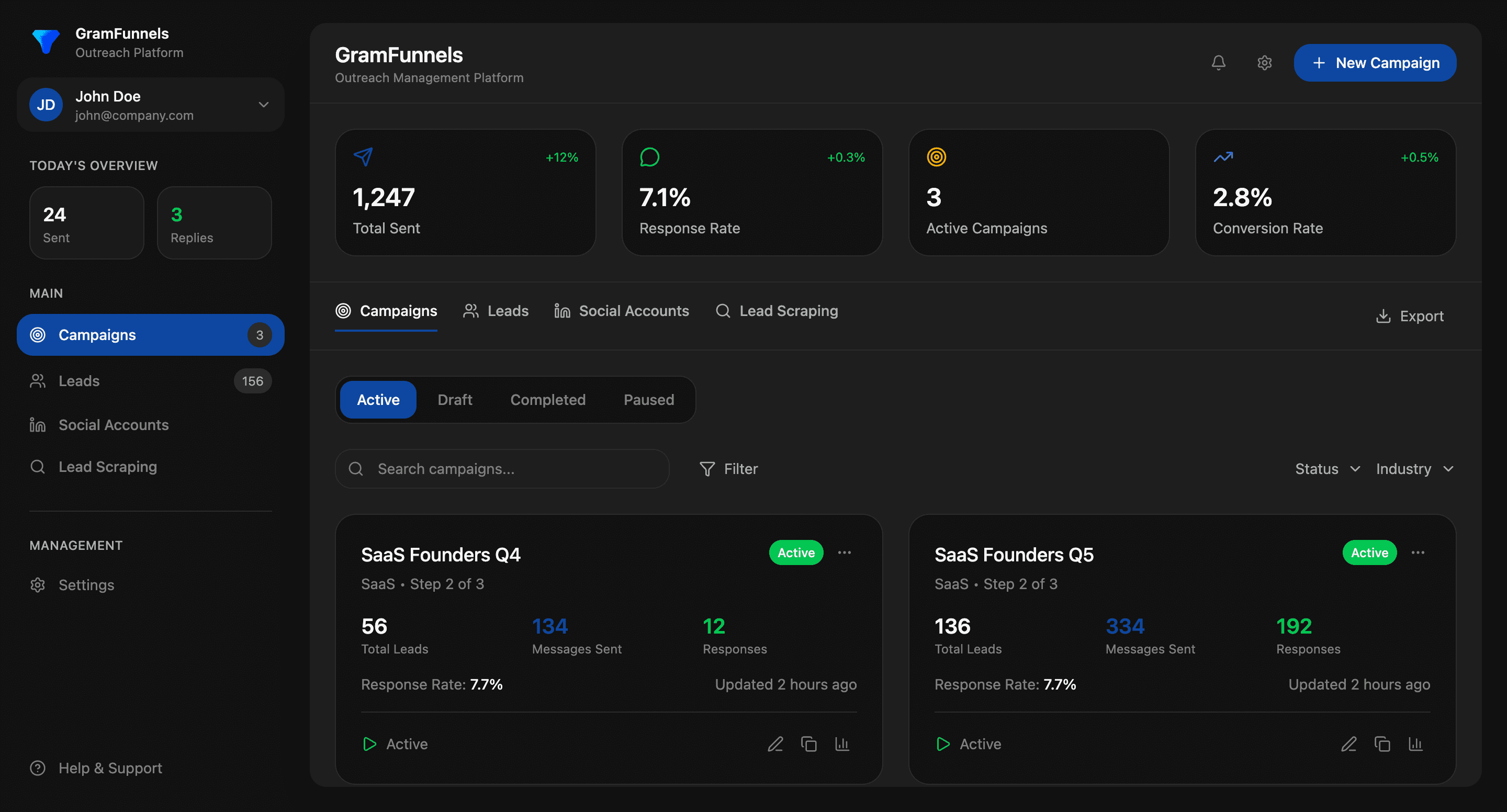
GramFunnels provides built-in cadence automation with configurable gap timing, AI-powered personalization, and real-time safety monitoring to keep your account healthy while you scale. Our done-for-you service also means we manage timing and compliance so you focus on closing deals.
For comprehensive safety best practices, explore our Growth Strategy guide for X Automation.
Conclusion: Your Cadence Roadmap
The highest-converting DM sequences aren't random. They're strategically timed, thoughtfully spaced, and continuously optimized. Start with a 5-touch sequence spaced 2-5 days apart, track your reply rates religiously, and adjust based on data.
Remember: the goal isn't to send more messages. It's to send the right message at the right time to the right person. When your cadence aligns with how prospects actually buy, your response rates will soar.
Ready to systematize your cadence? Build your first sequence today and watch how strategic timing transforms your outreach results.