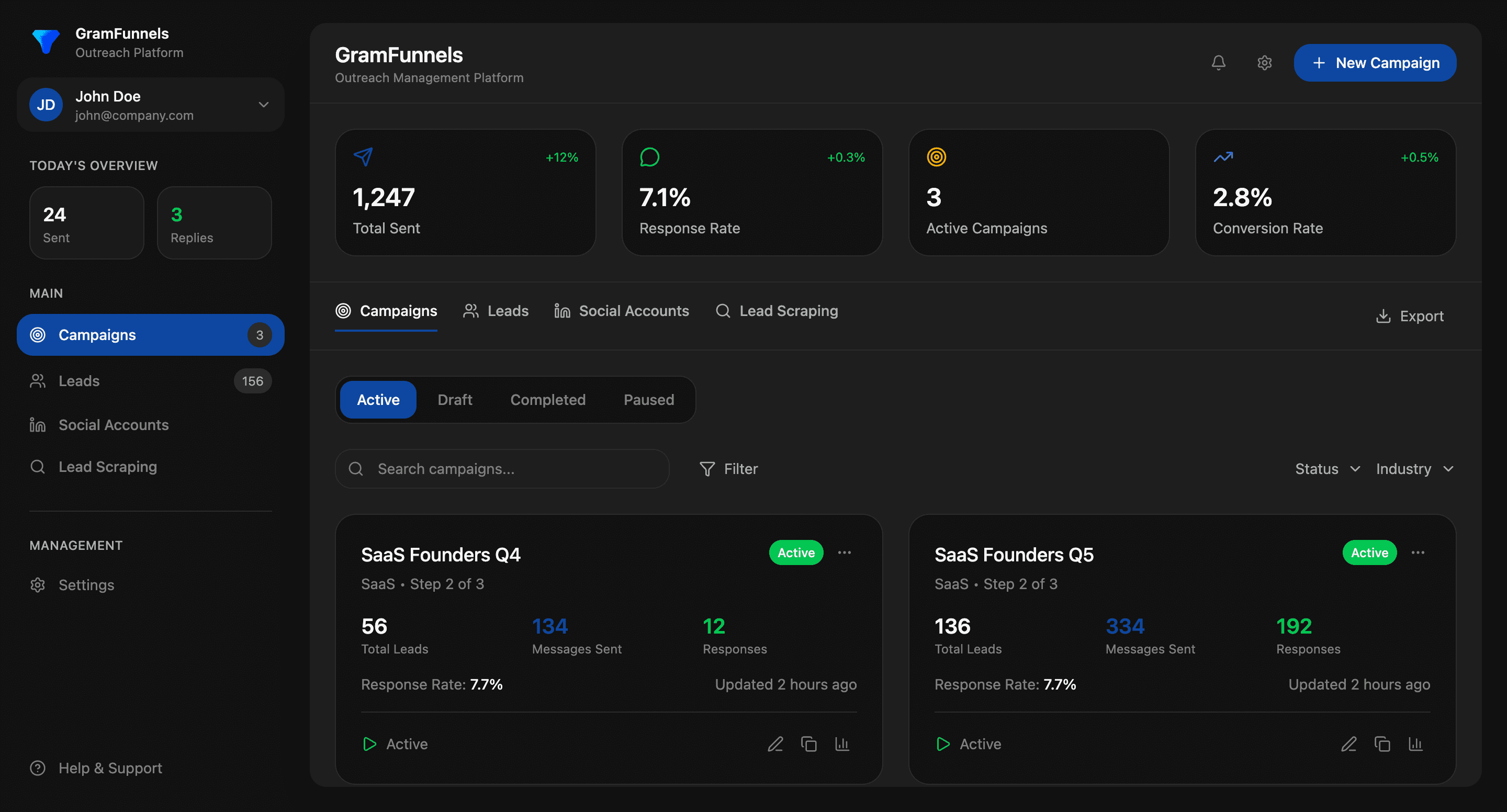
Most sales teams track activity metrics like emails sent and calls made. But here's the uncomfortable truth: activity doesn't equal results.
The real power lies in understanding outreach metrics-the data points that reveal whether your outreach efforts are actually generating meetings, deals, and revenue.
This guide walks you through every metric that matters, how to calculate them, industry benchmarks, and actionable strategies to improve each one. Whether you're running a solo outreach campaign or managing a multi-person sales team, these insights will transform how you measure and optimize your results.
What Are Outreach Metrics and Why They Matter
Outreach metrics are quantifiable measurements that track the performance and effectiveness of your outreach campaigns. They answer critical questions like:
- How many prospects are responding to my messages?
- What percentage of conversations convert to meetings?
- Which messaging resonates most with my target audience?
- Where are prospects dropping off in my funnel?
- What's my actual return on outreach effort?
Without proper tracking, you're flying blind. You might believe your outreach is working when it's actually underperforming-or you might abandon a strategy that's generating excellent results because you never measured it correctly.
The difference between tracking activity and tracking outcomes is the difference between looking busy and driving results.
The Core Outreach Metrics You Need to Track
1. Open Rate
Definition: The percentage of outreach messages that are opened by the recipient.
Formula: (Messages Opened ÷ Messages Sent) × 100
Why It Matters: Open rate measures whether your subject lines and sender reputation are compelling enough to earn attention. It's your first filtering point.
Benchmark: For cold outreach on Twitter/X, typical open rates range from 15-30%, depending on audience relevance and account authority.
How to Improve:
- Test subject lines that create curiosity without overpromising
- Maintain sender reputation by avoiding spam triggers
- Segment audiences by relevance-more targeted sends drive higher opens
- Consider timing; sending during business hours typically improves visibility
- Use personalization cues (name, company mention) to increase open rates by 20-30%
2. Reply Rate
Definition: The percentage of outreach messages that receive a response.
Formula: (Replies Received ÷ Messages Sent) × 100
Why It Matters: Reply rate reveals whether your message resonates with prospects. It's a leading indicator of campaign effectiveness.
Benchmark: Industry-standard reply rates for cold outreach typically range from 2-5%, though personalized, well-targeted campaigns can reach 10-15%.
How to Improve:
- Lead with value, not asks-prospects reply when they see immediate benefit
- Keep messages short and scannable (3-5 sentences maximum)
- Create genuine connection through research-reference specific details about the prospect
- Ask a single, specific question that's easy to answer
- Use sequence cadence strategically; follow-ups typically improve reply rates by 30-40%
3. Conversion Rate (Response to Meeting)
Definition: The percentage of replies that convert into scheduled meetings or demos.
Formula: (Meetings Booked ÷ Replies Received) × 100
Why It Matters: This metric directly measures sales effectiveness. A high reply rate means nothing if conversations don't convert to meetings.
Benchmark: Effective sales teams typically convert 25-40% of positive replies into meetings.
How to Improve:
- Respond to replies immediately (within 1 hour when possible)
- Qualify quickly-ask discovery questions that uncover fit and urgency
- Make scheduling friction-free with calendar links or calendar integration
- Address objections proactively without being defensive
- Use social proof (case studies, testimonials) to build confidence
4. Cost Per Conversation (CPC)
Definition: The total cost of your outreach efforts divided by the number of meaningful conversations initiated.
Formula: (Total Outreach Cost ÷ Conversations Initiated) = CPC
Why It Matters: This metric measures efficiency. It helps you understand whether your outreach tool, time investment, and resources are generating conversations at reasonable cost.
How to Calculate: Include tool costs, labor (sales rep time), and any platform fees. Conversations initiated includes any response requiring engagement.
How to Improve:
- Use automation to reduce time-per-prospect while maintaining personalization
- Increase reply rates (more replies from same effort = lower cost per conversation)
- Improve list quality to reduce wasted outreach to poor-fit prospects
- Test different channels and sequences to find your most efficient combination
5. Meeting Attendance Rate
Definition: The percentage of scheduled meetings that prospects actually attend.
Formula: (Meetings Attended ÷ Meetings Scheduled) × 100
Why It Matters: Booked meetings mean nothing if prospects don't show up. This metric reveals how well you've qualified and if prospects are genuinely interested.
Benchmark: Typical meeting attendance rates range from 70-85%, though this varies by industry and prospect tier.
How to Improve:
- Send a reminder 24 hours before the meeting
- Confirm the meeting is on the prospect's calendar (not just in email)
- Make the value proposition crystal clear in the meeting invite
- Use tools that sync with calendar systems to reduce friction
6. Deal Value and Win Rate
Definition: Average value of deals generated from outreach, and the percentage of opportunities that close.
Formula (Win Rate): (Deals Won ÷ Deals in Pipeline) × 100
Why It Matters: Ultimately, outreach success means revenue. These metrics connect outreach efforts to actual business results.
Benchmark: Average sales win rates across industries range from 15-30%, depending on sales cycle length and product complexity.
How to Improve:
- Improve qualification to increase deal quality (fewer but higher-value deals)
- Refine your ideal customer profile (ICP) to focus on better-fit prospects
- Strengthen your sales process and discovery conversations
- Address objections earlier in the conversation
Secondary Metrics That Provide Important Context
Engagement Rate Beyond Open and Reply
Track not just opens and replies, but deeper engagement indicators:
- Profile views: Prospects visiting your profile indicate interest
- Click-through rate: Links in your message being clicked shows active interest
- Share or retweet rate: Indicates your content resonates beyond direct response
Time to First Reply (TTR)
Definition: Average time elapsed between sending outreach and receiving first response.
Why It Matters: Faster replies often indicate higher interest. TTR also helps you optimize sequence timing-knowing when replies come in helps you schedule follow-ups strategically.
Benchmark: Initial replies typically arrive within 24-72 hours of first message.
Unsubscribe/Block Rate
Definition: The percentage of recipients who unsubscribe or block you after receiving outreach.
Formula: (Unsubscribes + Blocks ÷ Messages Sent) × 100
Why It Matters: High unsubscribe rates indicate poor targeting or messaging that doesn't resonate. It also affects sender reputation and deliverability.
Benchmark: Healthy campaigns maintain unsubscribe rates below 0.5%.
How to Set Benchmarks for Your Specific Outreach Strategy
Industry benchmarks provide context, but your benchmarks should reflect your specific situation. Consider:
- Target audience: Outreach to C-level executives typically has lower reply rates than outreach to mid-level practitioners
- Industry vertical: Some industries (tech, SaaS) typically show higher engagement than others (traditional services)
- Message type: Value-first messages usually outperform immediate asks by 2-3x
- Personalization level: Highly personalized campaigns can improve reply rates by 40-60% versus templated messages
- Outreach channel: Direct messages on Twitter/X can show different performance than email
Rather than chasing absolute benchmarks, focus on continuous improvement. Test variations, measure results, and implement learnings systematically.
Building an Outreach Metrics Dashboard
Tracking metrics manually quickly becomes unmanageable. A proper outreach dashboard consolidates key data so you can spot trends and opportunities quickly.
Essential Dashboard Components
- Campaign performance overview: Reply rates, conversion rates, and cost per conversation at a glance
- Funnel visualization: How many prospects move through each stage (sent → opened → replied → meeting booked → deal closed)
- Trend analysis: Week-over-week and month-over-month changes in key metrics
- Team performance: Individual rep metrics for accountability and identification of top performers
- Channel comparison: Performance across different outreach channels (Twitter/X DMs vs. email vs. other platforms)
- Cohort analysis: How different messaging variants, sequences, or audience segments perform
Tools for Tracking Outreach Metrics
Many modern sales and outreach platforms include built-in analytics. Key features to look for:
- Automated open and click tracking
- Reply detection and classification
- CRM integration to track outcomes
- A/B testing capabilities
- Customizable reporting and dashboards
The best tool integrates with your existing CRM so metrics flow automatically into your system without manual data entry.
Common Outreach Metrics Mistakes to Avoid
Mistake 1: Vanity Metrics Over Revenue Metrics
The Problem: Celebrating high open rates while ignoring low conversion rates. Activity metrics feel good but don't prove success.
The Fix: Always connect activity to outcomes. Your north star metric should be revenue or revenue-generating activities (meetings booked, deals closed).
Mistake 2: Not Segmenting Your Data
The Problem: Averaging metrics across all campaigns hides what's actually working. A campaign with 3% reply rate might include pockets of 10%+ performance in specific segments.
The Fix: Slice your data by message variant, audience segment, campaign, and messaging approach. This reveals optimization opportunities.
Mistake 3: Ignoring Time-to-Action
The Problem: Measuring only whether something happened, not when it happened. A reply after 7 days indicates different interest than a reply after 2 hours.
The Fix: Track time-to-first-reply, time-to-meeting, and time-to-close. These metrics reveal momentum and urgency.
Mistake 4: Not Accounting for Quality Differences
The Problem: 100 replies from low-fit prospects isn't better than 20 replies from ideal customers.
The Fix: Layer qualification into your metrics. Track conversion rate separately for prospects meeting your ICP versus outside it.
Connecting Outreach Metrics to Revenue Impact
The ultimate test of outreach metrics is: do they correlate with revenue?
For example, if your reply rate is 5% and conversion to meeting is 30%, then a 10% improvement in reply rate should generate 30% more meetings, assuming all else remains equal.
To validate this:
- Pick a metric to optimize (e.g., reply rate)
- Implement a specific change (e.g., shorter message length)
- Run test group for 100+ prospects
- Compare test group metrics to control group
- Track resulting meetings and opportunities to revenue impact
This approach proves that your optimization efforts actually drive business results, not just vanity metrics.
Key Takeaways
Outreach metrics transform sales from guesswork into science. By tracking the right KPIs-reply rate, conversion to meeting, cost per conversation, and ultimately revenue-you gain visibility into what's working and where to invest optimization effort.
The best performing teams don't just measure activity; they measure outcomes and constantly improve the conversion rate between activity and results.
Start with the core metrics outlined here, build dashboards for visibility, and test improvements systematically. Over time, you'll develop repeatable processes that consistently turn outreach into revenue.
Learn more about optimizing your outreach strategy with our complete guide to DM sequences and cadence for high-converting X outreach, and explore how building a social funnel strategy connects outreach metrics to sales success. For B2B teams scaling outreach, check out our guide on managing multi-account outreach safely.