Social Media Marketing: Organic and Paid Growth Strategies for Maximum ROI
Social media marketing has evolved from a nice-to-have to an essential component of any modern business strategy. Whether you're running a B2B SaaS company, an e-commerce store, or a service-based business, having a solid social media marketing plan can make the difference between obscurity and market dominance.
The challenge? Most businesses treat organic and paid social media marketing as separate silos. The truth is, the most successful brands integrate both approaches into a cohesive strategy that maximizes reach, engagement, and conversions.
In this guide, we'll explore proven organic and paid social media marketing tactics, share real-world examples, and show you how to build a sustainable growth engine on social platforms.
Understanding Social Media Marketing: Organic vs. Paid
Before diving into specific tactics, let's clarify the two primary pillars of social media marketing:
Organic Social Media Marketing involves building your audience and engagement through unpaid content. This includes:
- Regular, high-quality posts that provide value
- Community engagement and conversations
- Hashtag optimization
- Collaborations and partnerships
- User-generated content campaigns
Paid Social Media Marketing leverages advertising budgets to amplify reach and targeting. This includes:
- Sponsored posts and ads
- Retargeting campaigns
- Lead generation campaigns
- Brand awareness initiatives
- Lookalike audience targeting
The most effective social media marketing strategies blend both approaches. Organic builds trust and community; paid accelerates growth and drives measurable conversions.
Organic Social Media Marketing Strategies That Drive Real Growth
Organic social media marketing is a marathon, not a sprint. Here's how to build sustainable growth:
1. Create Content That Solves Problems
The foundation of organic social media marketing is creating content that your audience actually wants to consume. This means moving beyond self-promotional posts to educational, entertaining, or inspiring content.
For example, if you're a project management tool, instead of posting "Check out our new features," create a post like "5 ways most teams waste 10 hours per week on task management." This positions you as an expert and drives engagement.
Action items:
- Conduct audience research to identify pain points
- Create content that addresses these specific problems
- Use a 80/20 rule: 80% value, 20% promotion
- Test different content formats (videos, carousels, infographics)
2. Optimize Your Posting Schedule and Frequency
Data shows that posting consistency matters more than frequency. According to recent studies, posting 3-5 times per week on most platforms delivers better engagement than sporadic daily posting.
The optimal posting times vary by platform and audience. For B2B audiences, Tuesday-Thursday at 9 AM and 5 PM typically see higher engagement. For B2C, the sweet spots are often 10 AM and 7 PM.
However, the best approach is to analyze your specific audience's behavior through platform analytics and adjust accordingly.
3. Leverage Hashtags and Keyword Research
Hashtags remain one of the most underutilized organic social media marketing tools. A strategic hashtag approach can increase visibility by 30-50%.
Best practices:
- Mix high-volume and niche hashtags (e.g., #socialmedia + #b2bmarketing)
- Research competitor hashtags to find your audience
- Create branded hashtags for campaigns
- Place 20-30% of hashtags in replies rather than main post
- Rotate hashtags weekly to stay relevant
4. Build Community Through Engagement
Organic social media marketing isn't just about broadcasting-it's about building relationships. Brands that actively engage with their audience see 3x higher engagement rates than those that simply post.
Spend time daily:
- Responding to comments within the first hour
- Engaging with competitor followers' content
- Participating in relevant conversations
- Asking questions in your captions
- Featuring user-generated content
Paid Social Media Marketing: Maximizing Ad Spend ROI
Paid social media marketing allows you to scale growth quickly. Here's how to maximize your investment:
1. Define Clear Campaign Objectives
Before spending a dollar, know exactly what you want to achieve. Paid social platforms (Meta, TikTok, LinkedIn, etc.) optimize for specific objectives:
- Awareness: Build familiarity with your brand
- Consideration: Drive clicks, video views, or app installs
- Conversion: Generate sales, leads, or app purchases
Your objective determines your targeting strategy, creative approach, and success metrics.
2. Segment Your Audience and Build Lookalikes
The most successful paid social media marketing campaigns use audience segmentation. Rather than showing the same ad to everyone, segment by:
- Awareness stage: Broad targeting, brand awareness focus
- Consideration stage: Website visitors, engagement audiences
- Decision stage: Past purchasers, high-intent audiences
Create lookalike audiences based on your best customers-this typically outperforms cold targeting by 2-3x.
3. Design Creative That Converts
In paid social media marketing, creative is king. Your ad copy and visuals determine success more than targeting or bid strategy.
Proven creative strategies:
- Lead with your offer or benefit (first 3 seconds crucial)
- Use contrast and movement to stop thumb-scrolling
- Include social proof (testimonials, numbers, case studies)
- Create multiple variations (A/B testing)
- Test both video and static image formats
- Use vertical video for mobile (9:16 aspect ratio)
4. Implement Retargeting Campaigns
Retargeting is one of the highest ROI tactics in paid social media marketing. People who've already visited your website are 70% more likely to convert than cold audiences.
Build retargeting audiences for:
- Website visitors (all traffic)
- Product page visitors (high-intent)
- Cart abandoners (immediate conversion focus)
- Past customers (upsell/cross-sell)
- Video viewers (engagement-based)
5. Master Attribution and Analytics
To optimize your paid social media marketing budget, you must understand which campaigns drive actual results. This means tracking beyond platform-native metrics.
Key metrics to monitor:
- Cost Per Lead (CPL)
- Cost Per Acquisition (CPA)
- Return on Ad Spend (ROAS)
- Customer Lifetime Value (CLV)
- Attribution by touchpoint
Use UTM parameters to track which campaigns drive revenue, not just clicks.
Instagram Growth Strategies: Organic and Paid Integration
Instagram remains one of the most powerful platforms for social media marketing. Here's how to grow both organically and with paid tactics:
Organic Instagram Growth
Instagram's algorithm prioritizes content that drives engagement and time spent on platform. To grow organically:
- Post consistently: 4-5 times weekly for business accounts
- Use Reels: Video content receives 67% more engagement than static posts
- Engage strategically: Spend 15-20 minutes daily engaging with followers and similar accounts
- Optimize captions: Include calls-to-action and encourage saves/shares
- Use Stories strategically: Stories increase your chance of appearing in followers' feeds
Paid Instagram Advertising
Instagram ads benefit from the platform's detailed targeting capabilities:
- Target by interests, behaviors, and demographics
- Use carousel ads to showcase multiple products
- Leverage shopping features for e-commerce
- Create collection ads for immersive experiences
- Use video ads (30-60 seconds) for higher engagement
Social Media Marketing Tools and Automation
Managing organic and paid social media marketing manually is time-consuming. Modern tools help streamline the process.
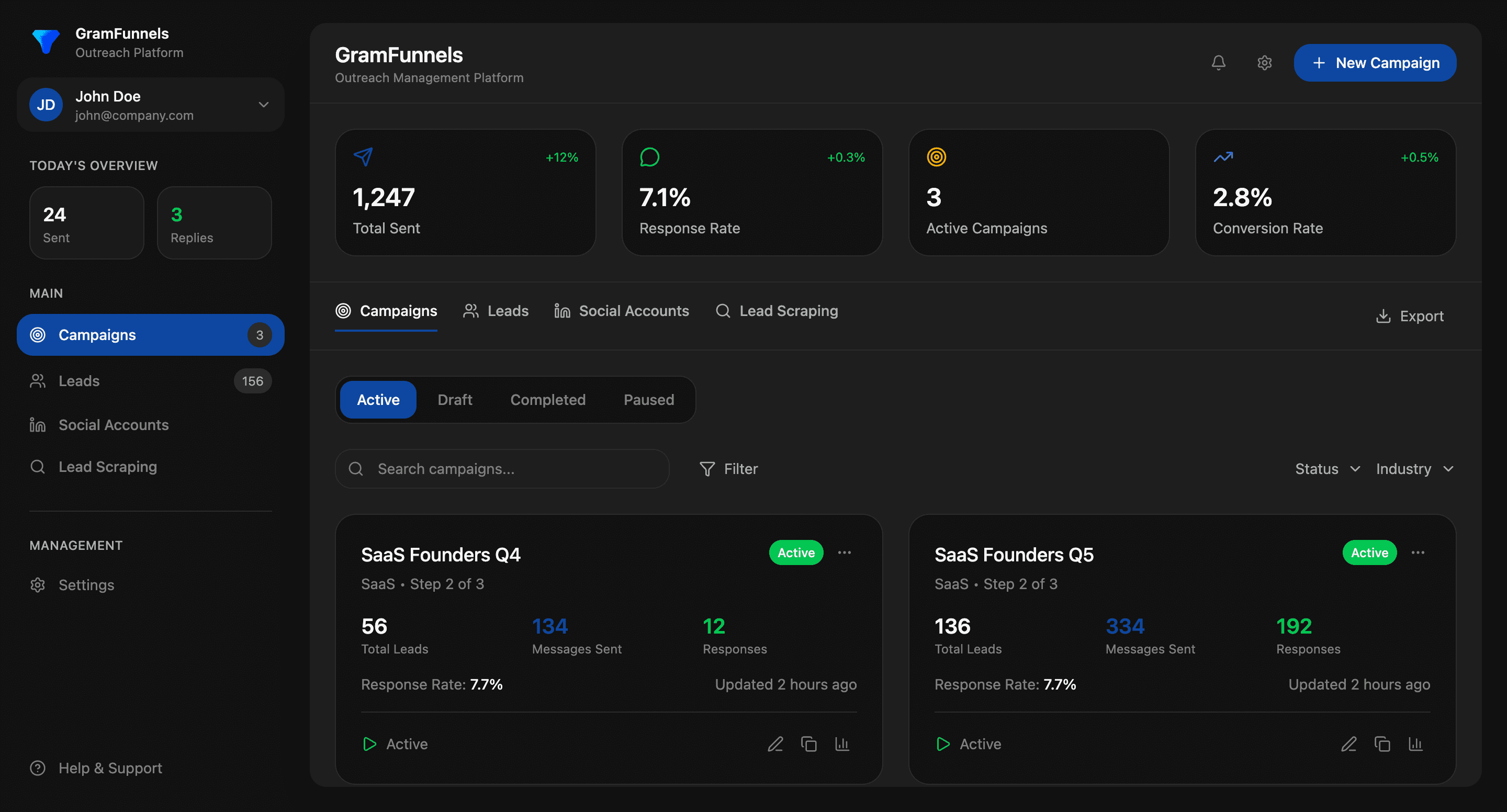
For Twitter/X outreach specifically, tools like GramFunnels automate DM sequences and lead generation, allowing you to build relationships at scale. If you're looking to compare options, explore alternatives for social media automation to find the right fit for your team.
General social media marketing tools help with:
- Content scheduling and posting
- Analytics and reporting
- Competitor monitoring
- Audience insights
- Multi-account management
Measuring Social Media Marketing Success
You can't optimize what you don't measure. Establish clear KPIs before launching campaigns:
Top-of-funnel metrics:
- Reach and impressions
- Engagement rate
- Follower growth rate
Mid-funnel metrics:
- Click-through rate (CTR)
- Traffic to website
- Leads generated
Bottom-funnel metrics:
- Conversions
- Revenue
- Customer acquisition cost (CAC)
For B2B social media marketing specifically, understanding essential KPIs helps you connect social efforts to pipeline and revenue.
Building Your Integrated Social Media Marketing Plan
Here's how to combine organic and paid tactics into a cohesive strategy:
Month 1-2: Foundation
- Audit current accounts and set benchmarks
- Define audience personas and pain points
- Create content calendar (4-6 weeks in advance)
- Set up analytics and tracking
Month 3-4: Optimization
- Launch organic content consistently
- Begin small paid campaigns to test creative
- Analyze engagement and adjust messaging
- Build retargeting audiences
Month 5+: Scale
- Increase ad budget to high-performing campaigns
- Double down on organic content that resonates
- Expand to new platforms or audience segments
- Optimize for revenue, not just vanity metrics
Common Social Media Marketing Mistakes to Avoid
Learning from others' mistakes accelerates your success:
- Being too promotional: 80/20 value-to-promotion ratio works better
- Ignoring analytics: Gut-feel decisions cost money; data-driven decisions save it
- Inconsistency: Sporadic posting kills momentum and algorithm favor
- Not engaging: Broadcasting without conversation limits growth
- Wrong audience targeting: Precise targeting beats broad reach
- Poor creative quality: Blurry images and unclear messaging kill ROI
- Slow response time: Responding to comments within the first hour boosts engagement 50%+
The Future of Social Media Marketing
Social media marketing continues to evolve. Key trends shaping 2025:
- AI-powered personalization: Dynamic content tailored to individual user behavior
- Short-form video dominance: Reels and TikTok drive engagement more than static posts
- Community-first platforms: Private communities and Discord over public feeds
- Authenticity over perfection: Real, behind-the-scenes content outperforms polished ads
- Conversion-focused metrics: Focus shifting from vanity metrics to actual revenue
Conclusion: Start Your Social Media Marketing Journey Today
Social media marketing doesn't require massive budgets or years of experience. It requires strategy, consistency, and willingness to adapt based on data.
Start with these fundamentals:
- Choose 1-2 platforms where your audience lives
- Create a 4-week content calendar
- Commit to 30 minutes daily of organic engagement
- Launch small paid tests to understand your audience
- Measure, analyze, and optimize continuously
The brands winning at social media marketing today aren't waiting for perfect-they're executing consistently and improving based on real data. That can be you.
Ready to scale your social media marketing efforts? Explore how DM automation can help you build relationships at scale on platforms like Twitter/X.