TweetHunter was once a go-to tool for Twitter marketers hunting viral content and engagement metrics. But if you're here searching for a TweetHunter alternative, you likely discovered what many sales teams already know: you need an outreach-focused solution, not a content analytics platform.
The shift is real. What worked for Twitter engagement in 2020 doesn't cut it for modern sales automation in 2025. Today's revenue teams need tools built specifically for X automation, DM outreach, lead generation, and pipeline building-not just trending topic analysis.
In this guide, we'll break down why teams are moving away from TweetHunter, what they're switching to, and how to build a scalable outreach playbook that actually converts prospects into pipeline.
Why Teams Are Abandoning TweetHunter for X Automation Tools
TweetHunter positioned itself as a content discovery and analytics platform. It helped marketers identify trending tweets, track engagement, and find viral content opportunities. For content teams, that had real value.
But here's the problem: content discovery ≠ sales automation.
When sales teams and SDRs tried forcing TweetHunter into their workflow, they ran into critical limitations:
- No direct outreach capabilities-TweetHunter couldn't automate DM sequences or cold outreach at scale
- No lead targeting with keyword filtering-You couldn't systematically find prospects matching your ideal customer profile (ICP)
- No CRM integration-Leads discovered weren't automatically synced to your sales stack
- No proxy infrastructure or rate limiting controls-Account safety was left to chance when scaling outreach
- Limited automation workflows-Manual prospecting still required heavy lifting from your team
In short: TweetHunter was built to answer "What's trending?" not "How do I systematically find and convert my ideal customers?"
What Modern Sales Teams Need: The TweetHunter Alternative Checklist
Before jumping to a replacement tool, let's define what actually moves the needle for outbound sales on X:
Lead Generation with Precision Targeting
The best TweetHunter alternatives let you filter prospects by keywords, bios, follower counts, engagement patterns, and location. You're not hunting viral content-you're hunting your specific buyer.
Example: A SaaS founder selling project management software needs to find CTOs and engineering managers discussing "team productivity" or "project bottlenecks." A modern alternative should surface those exact profiles systematically.
Automated DM Sequences That Convert
One-off DMs rarely convert. You need tools that support multi-step DM cadences with personalization variables, wait times between messages, and conditional logic based on engagement.
The difference: A cold outreach tool sends personalized DM sequences at scale. TweetHunter just helped you find who to message.
Deliverability and Account Safety
Scaling DM outreach comes with risk. X has rate limits, spam detection, and account suspension policies. Modern tools include:
- Proxy infrastructure to distribute requests safely
- Throttling settings to stay within X's limits
- Real-time monitoring for account health
- Best practices to avoid action blocks
CRM Integration and Pipeline Tracking
Leads discovered should flow directly into your CRM. Replies should be tracked. Conversions should be measured. A fragmented workflow kills productivity.
Team Collaboration Features
Sales teams don't operate solo. The best tools support multi-account management, role-based permissions, shared playbooks, and performance analytics across the team.
Top TweetHunter Alternatives for Sales Automation in 2025
GramFunnels: Built for X Outreach and Lead Generation
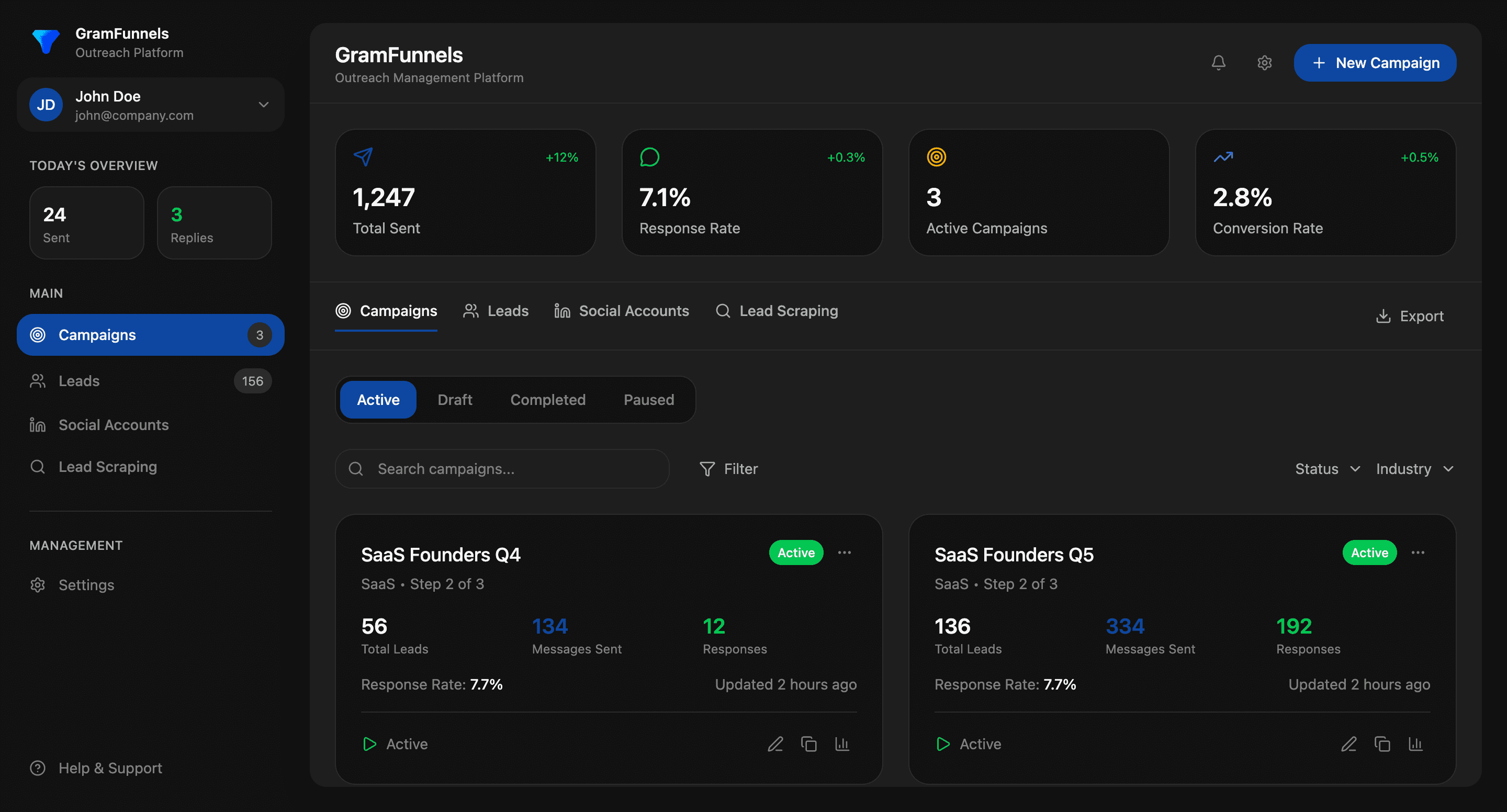
GramFunnels is purpose-built for what TweetHunter couldn't do: systematic lead generation and automated DM outreach on X.
Here's what sets it apart:
- AI-powered lead discovery-Find prospects matching your ICP using keyword targeting, bio filters, and engagement signals
- Automated DM sequences-Build multi-step workflows with personalization, wait times, and follow-up logic
- Done-for-you service-GramFunnels teams can manage outreach campaigns end-to-end, handling targeting, messaging, and analytics
- Proxy infrastructure and rate limiting-Scale safely without triggering X's spam detection or account blocks
- CRM integrations-Sync leads, conversations, and conversion data directly to your sales stack
- Team management-Collaborate across multiple accounts with shared playbooks and performance dashboards
Best for: B2B companies, SaaS teams, agencies, and consultants building systematic outbound sales motions on X.
Other Viable Alternatives
Drippi is another X-focused automation platform offering lead targeting, DM automation, and growth features. It's a solid alternative if you need a lighter-weight solution, though it lacks some of GramFunnels' advanced team collaboration and CRM integration depth.
Note: Tools like Hootsuite, Buffer, and Later are not viable TweetHunter alternatives for outbound sales. They're multi-platform social management tools optimized for content publishing, not X-specific lead generation and cold outreach automation.
Building a Scalable X Outreach Playbook: From Lead Gen to Pipeline
Finding the right tool is step one. Building a system that actually converts is step two. Here's the playbook top-performing sales teams use:
Step 1: Define Your ICP and Build Search Filters
Your outreach quality depends on targeting precision. Before launching campaigns:
- Document your ideal customer: industry, company size, job title, pain points
- Identify keywords your ICP discusses: "struggling with workflows," "need better team collaboration," etc.
- Build 3-5 different keyword combos in your X automation tool to surface different buyer segments
- Set engagement filters: minimum followers (credibility), reply rate (engagement quality)
Real example: A sales engagement platform targeting sales leaders might filter for accounts mentioning "sales pipeline," "quota," or "team coaching"-combined with the job title "VP Sales" or "Sales Manager."
Step 2: Craft DM Sequences That Get Replies
The first message matters, but so does the follow-up sequence. Check out our guide on cold DM scripts for founders to see what actually converts.
Best practices for DM sequences:
- Message 1: Quick intro + specific reason you're reaching out (tie to their interests/company)
- Wait 48-72 hours before follow-up (respect their inbox)
- Message 2: Social proof + value prop (what's in it for them, backed by data)
- Wait 5-7 days if no reply
- Message 3: Final touch-ask for a specific next step (call, email, check out asset)
Personalization is non-negotiable. Tools that support variable injection ({{firstName}}, {{company}}, {{recentTweet}}) show 3-5x higher reply rates than generic templates.
Step 3: Set Throttling and Safety Guardrails
Scaling DM volume without getting blocked requires discipline. Your X automation tool should let you configure:
- Daily outreach limits: Start at 50-75 new prospects/day, monitor for blocks
- Proxy rotation: Distribute requests across IPs to avoid rate limiting
- Action block monitoring: Real-time alerts if X restricts your account temporarily
We've documented the complete throttling and safety settings guide for X outreach-critical reading if you're scaling.
Step 4: Track, Measure, Optimize
Set up dashboards to track:
- Messages sent vs. messages delivered (deliverability %)
- Replies received (reply rate)
- Replies that lead to email/call (conversion rate)
- Pipeline created (revenue impact)
Benchmark: B2B outbound teams see 8-15% reply rates on cold DMs when sequences are well-crafted and targeting is precise. If you're below 5%, revisit your messaging or audience.
Step 5: Sync Everything to Your CRM
Conversations on X are useless if they're siloed. Your X automation tool must integrate with your CRM so:
- New prospects auto-create leads in your CRM
- Replies are logged as activities
- Conversations can be handed off to sales reps
- Pipeline data flows back into your analytics
Our CRM integrations guide walks through setup for Salesforce, HubSpot, Pipedrive, and other major platforms.
TweetHunter Alternative Comparison: Quick Reference
GramFunnels
- ✓ Lead generation with keyword targeting
- ✓ Automated DM sequences
- ✓ Proxy infrastructure and safety controls
- ✓ CRM integrations
- ✓ Team management
- ✓ Done-for-you campaigns
Drippi
- ✓ Lead targeting on X
- ✓ DM automation
- ✓ Growth features
- ✗ Limited CRM depth
- ✗ Fewer team collab tools
TweetHunter
- ✓ Content analytics
- ✓ Viral tracking
- ✗ No outreach automation
- ✗ No lead targeting
- ✗ No CRM integration
Common Mistakes When Switching from TweetHunter
Mistake 1: Launching Campaigns Without Testing Sequences
Many teams go from discovery to scale in 72 hours. Bad move. Test your DM sequence with 20-30 prospects first. Measure reply rates. Refine messaging. Then scale to 500+ prospects.
Mistake 2: Ignoring Account Safety
X's spam detection is sophisticated. Blasting 500 DMs on day one? Expect an action block. Use your tool's throttling settings. Scale gradually. Monitor account health daily.
Mistake 3: Poor Data Hygiene
Targeting bots, inactive accounts, and irrelevant profiles kills your metrics. Spend time building clean keyword filters. Use engagement minimums. Exclude industries/roles that don't match your ICP.
Mistake 4: No Follow-Up Sequence
Single DMs convert at 2-4%. Multi-step sequences convert at 10-15%. Your alternative should support at least 2-3 follow-ups over 7-14 days.
Getting Started with Your Next X Automation Tool
Ready to move beyond TweetHunter?
- Define your ICP: Who are you targeting? What keywords do they use?
- Choose your tool: Try a free trial with GramFunnels or Drippi. Test lead targeting and message templates.
- Build your first sequence: Start with 3-5 DMs over 14 days. Get 5-10 replies to validate the concept.
- Implement CRM sync: Get leads flowing into your sales stack immediately.
- Scale methodically: Increase daily outreach by 25-50% weekly as you monitor safety metrics.
For deeper playbook guidance, check out our complete DM sequences and cadence guide and SDR playbooks for X.
The Bottom Line
TweetHunter served a purpose in the old Twitter marketing playbook. But modern revenue teams need more: systematic lead generation, automation at scale, account safety, and CRM integration.
The best TweetHunter alternative isn't just a replacement-it's a complete outreach operating system. Whether you choose GramFunnels, Drippi, or another X-focused platform, prioritize:
- Precision lead targeting
- Convertible DM sequences
- Account safety infrastructure
- CRM integration
- Team collaboration
Your 2025 growth strategy depends on it. X isn't going anywhere-and neither is cold outreach. But the tools have evolved. Make sure yours keeps up.