Unlock effective lead generation with these top 5 Sales Navigator alternatives that can supercharge your sales strategy and boost conversions. While LinkedIn Sales Navigator has long been the go-to platform for B2B prospecting, it's not the only solution available, and depending on your specific needs, budget, and sales process, other tools might deliver better results for your team.
The lead generation landscape has evolved dramatically. Today's sales teams need more than just contact data-they need intent signals, multi-channel capabilities, automation, and seamless integration with their existing tech stack. Whether you're looking for more affordable options, better data accuracy, or features that Sales Navigator simply doesn't offer, this comprehensive guide will help you find the right tool for your business.
Why Consider Alternatives to Sales Navigator?
LinkedIn Sales Navigator is undeniably powerful, but several valid reasons might prompt you to explore alternatives for your lead generation efforts.
Cost considerations top the list for many businesses. At $99.99 per user per month for the Professional plan and significantly more for Team and Enterprise tiers, Sales Navigator represents a substantial investment. For startups, small businesses, or teams with multiple sales reps, these costs can quickly become prohibitive. Many alternatives offer comparable or even superior functionality at a fraction of the price.
Data limitations present another challenge. Sales Navigator restricts the number of InMail messages you can send and limits how many profiles you can save. For high-volume prospecting operations, these constraints can bottleneck your outreach efforts. Additionally, Sales Navigator focuses exclusively on LinkedIn data, which means you're missing prospects who aren't active on the platform or whose profiles are incomplete.
Feature gaps become apparent when you need capabilities beyond basic LinkedIn prospecting. Sales Navigator doesn't provide verified email addresses, phone numbers, or multi-channel outreach automation. It also lacks the sophisticated intent signal tracking that modern sales teams increasingly rely on to identify prospects who are actively in-market for solutions.
Platform dependency creates risk. Relying solely on LinkedIn means your entire lead generation strategy is vulnerable to platform changes, algorithm updates, or account restrictions. Diversifying your prospecting toolkit reduces this risk and opens up additional channels to reach your target audience.
Finally, workflow efficiency matters. Many sales teams find that integrating Sales Navigator data with their CRM, email platforms, and other tools requires manual work or expensive third-party integrations. Alternative platforms often provide more seamless workflows and native integrations that save time and reduce errors.
Criteria for Evaluating Sales Navigator Alternatives
Not all lead generation tools are created equal. To make an informed decision, evaluate alternatives against these critical criteria:
Data quality and coverage should be your primary concern. The best tool in the world is useless if it provides inaccurate contact information or missing data fields. Look for platforms with high data accuracy rates (95%+ for email verification), regular data refreshes, and comprehensive coverage of your target markets. Consider whether the tool provides direct dials, mobile numbers, and verified emails-not just company information.
Search and filtering capabilities determine how precisely you can define your ideal customer profile. Advanced filters for company size, revenue, technology stack, funding events, hiring patterns, and job changes enable more targeted prospecting. The ability to create and save custom search criteria saves time and ensures consistency across your team.
Intent signal detection separates modern platforms from legacy databases. Tools that identify prospects showing active buying behavior-such as high-intent buyer signals like competitor engagement, solution research, or job changes-dramatically improve conversion rates by helping you reach prospects at the right moment.
Integration ecosystem affects how well the tool fits into your existing workflow. Native integrations with popular CRMs (Salesforce, HubSpot, Pipedrive), email platforms (Gmail, Outlook), and sales engagement tools eliminate data silos and manual data entry. API access enables custom integrations for more sophisticated operations.
Automation capabilities multiply your team's effectiveness. Look for features like automated list building, sequence enrollment, follow-up scheduling, and AI-powered personalization. However, ensure automation doesn't sacrifice quality-the best tools balance efficiency with genuine personalization.
Compliance and data privacy can't be overlooked. With GDPR, CCPA, and other regulations, your lead generation tool must provide compliant data sourcing, opt-out mechanisms, and proper data handling. Non-compliance can result in hefty fines and reputation damage.
Pricing structure and scalability should align with your growth trajectory. Consider not just the current cost but how pricing scales as you add users, increase contact exports, or access premium features. Some platforms charge per user, others per contact, and some offer usage-based pricing.
Alternative #1: LinkedIn Recruiter
While technically another LinkedIn product, LinkedIn Recruiter deserves consideration as a Sales Navigator alternative, particularly for companies that also hire for their teams or consultants who work with multiple organizations.
What it offers: LinkedIn Recruiter provides advanced search capabilities across LinkedIn's entire member base, including passive candidates who aren't actively job hunting. You get 150 InMail credits per month (more than Sales Navigator's 50), unlimited people browsing, and the ability to create and manage projects for different hiring or prospecting campaigns.
The platform excels at finding decision-makers and potential clients within specific industries, companies, or roles. Its search filters are more extensive than Sales Navigator's, allowing you to identify prospects based on skills, certifications, groups, interests, and activity patterns. The ability to search by "open to opportunities" signals can help identify prospects who are considering changes and may be more receptive to conversations.
Key advantages: LinkedIn Recruiter's InMail messages often see higher response rates than standard messages because they signal importance and bypass connection requirements. The platform's project management features help organize prospects across different campaigns or client accounts. For agencies, the Recruiter Lite option provides a more affordable entry point than full Sales Navigator Team licenses.
Limitations: LinkedIn Recruiter is primarily designed for recruiting, not sales prospecting. The interface and workflows assume you're hiring, which can feel awkward when doing business development. At $170+ per month, it's more expensive than Sales Navigator Professional. You still face LinkedIn's platform constraints around daily limits and profile access restrictions.
Best for: Companies that need both recruiting and business development capabilities, consultants who work across multiple client accounts, or sales teams targeting HR and talent acquisition leaders who are naturally more active on LinkedIn Recruiter.
Alternative #2: Apollo.io
Apollo.io has rapidly become one of the most popular Sales Navigator alternatives, offering a comprehensive platform that combines database access, engagement tools, and analytics in a single interface.
What it offers: Apollo provides access to over 270 million contacts and 70 million companies with verified email addresses, direct dial phone numbers, and comprehensive firmographic data. The platform's Chrome extension works across LinkedIn, company websites, and other platforms, allowing you to enrich contact data wherever you work.
Beyond data access, Apollo includes built-in email sequencing, call dialing, and task management. This integrated approach means you can research prospects, build lists, launch outreach campaigns, and track engagement without switching between tools. The platform's AI-powered recommendations suggest similar prospects based on your ideal customer profile, and its intent data identifies companies researching solutions in your space.
Key features include:
- Advanced filtering by technographics (what technology companies use), funding events, hiring patterns, and company growth signals
- Email verification with deliverability scoring to protect sender reputation
- A/B testing for email sequences to optimize messaging
- Native integrations with Salesforce, HubSpot, and other major CRMs
- Team collaboration features including shared sequences and templates
- Analytics dashboard tracking email opens, clicks, replies, and conversion rates
Pricing: Apollo's free tier provides 50 mobile phone credits and 10 export credits per month, making it accessible for solopreneurs testing the platform. Paid plans start at $49 per user per month (Basic) and scale to $79 (Professional) and $119 (Organization) based on contact access, features, and support levels. This represents significant savings compared to Sales Navigator, especially for larger teams.
Strengths: The all-in-one approach eliminates the need for multiple tools, reducing costs and complexity. Data quality is generally strong, with email verification rates above 95%. The platform's constant updates and active community provide ongoing value. Apollo works well for both inbound and outbound teams, making it versatile for different go-to-market strategies.
Limitations: While comprehensive, Apollo's individual features may not match specialized tools. For example, dedicated email platforms like Mailshake or Lemlist offer more sophisticated email capabilities. Some users report inconsistent data quality for international contacts outside North America. The platform's extensive features can create a learning curve for new users.
Best for: Growing B2B companies seeking an affordable, all-in-one prospecting solution; sales teams that need both contact data and engagement tools; organizations wanting to consolidate their sales tech stack.
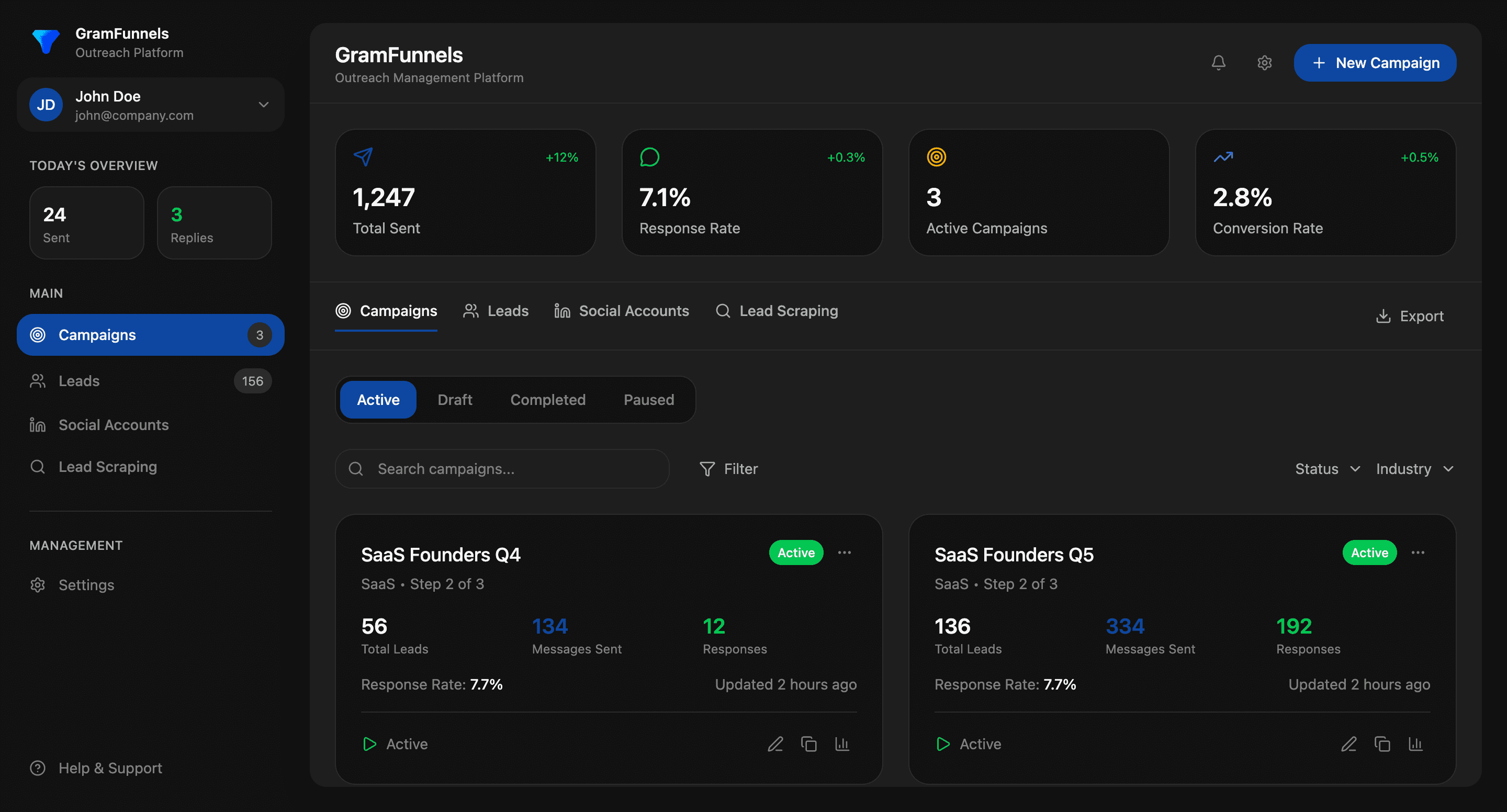
Alternative #3: GramFunnels
GramFunnels takes a fundamentally different approach to lead generation by focusing exclusively on high-intent prospecting through LinkedIn demand surface mapping and intent interception.
What it offers: Rather than providing a massive database of contacts, GramFunnels identifies prospects who are actively showing buying behavior right now. The platform tracks over 300 intent signals on LinkedIn-including competitor engagement, solution research, content interaction, job changes, and company growth indicators-to surface prospects who are genuinely in-market for solutions.
This intent-first methodology addresses a critical weakness in traditional lead generation: reaching prospects before they're ready to buy. By focusing on LinkedIn high-intent signals, GramFunnels helps sales teams concentrate their efforts on conversations that are far more likely to convert, rather than cold outreach to unqualified contacts.
The platform includes an AI SDR (Sales Development Rep) that automates prospecting, messaging, and follow-up 24/7. Crucially, GramFunnels runs outreach through external infrastructure, protecting your personal LinkedIn account and domain reputation from restrictions or bans-a significant advantage over tools that require you to risk your primary accounts.
Key features include:
- Demand Surface Mapping that visualizes where buying intent exists in your market
- Real-time intent monitoring across competitor content, industry discussions, and solution research
- AI-personalized outreach based on each prospect's specific behavior and activity
- External infrastructure for brand-safe outreach that protects your primary accounts
- Unified inbox managing conversations across multiple accounts in one place
- "Signal before scale" approach that validates market demand before investing in scaling
Pricing: GramFunnels offers two tiers designed for different team needs. The Starter plan ($99/month) provides 2 LinkedIn accounts, 1 AI SDR account, AI-personalized messaging, and external infrastructure. The Done-For-You plan ($500/month) is fully managed, delivering 300-500 messages per month to high-intent prospects, complete Demand Surface mapping, inbox management, warm handoffs, and guaranteed calendar bookings-with a commitment of 20 booked calls in 60 days or a full setup refund.
Strengths: The intent-based approach dramatically improves conversion rates compared to cold outreach. External infrastructure eliminates the risk of LinkedIn account restrictions that plague users of connection automation tools. The AI SDR provides enterprise-grade automation at accessible price points. The Done-For-You option works well for founders and executives who want results without managing campaigns themselves.
Limitations: GramFunnels focuses exclusively on LinkedIn, so it won't help teams doing multi-channel outreach across email, phone, and social. It's not a contact database-you won't export massive lists of emails. The platform works best for B2B companies with clearly defined ideal customer profiles on LinkedIn, making it less suitable for B2C or niche markets with limited LinkedIn presence.
Best for: B2B founders and sales leaders who want quality conversations over quantity metrics; companies burned by LinkedIn automation tools that got their accounts restricted; teams focused on account-based marketing to high-intent prospects; businesses that value conversion rates over activity volume.
Alternative #4: Hunter.io
Hunter.io has established itself as the go-to solution for finding and verifying professional email addresses, offering simplicity and accuracy that appeals to sales professionals worldwide.
What it offers: Hunter specializes in email discovery through a straightforward interface. Enter a company domain, and Hunter returns a list of email addresses associated with that organization, along with the email pattern the company uses (firstname.lastname@company.com, for example). The platform's Chrome extension makes this process seamless while browsing LinkedIn profiles or company websites.
Beyond basic email finding, Hunter provides email verification that checks deliverability in real-time, protecting your sender reputation. The platform also offers a domain search that shows all public email addresses associated with a company, helping you identify multiple potential contacts within target accounts.
Key features include:
- Domain search revealing email addresses and common patterns
- Email Finder for specific individuals based on name and company
- Bulk email verification for cleaning existing lists
- Confidence score indicating the likelihood of email accuracy
- Campaign tracking (in paid plans) for basic cold email outreach
- API access for integrating Hunter into custom workflows
- Data sourced from millions of public web pages, not purchased lists
Pricing: Hunter's free plan provides 25 email searches and 50 verifications per month, perfect for occasional prospecting needs. Paid plans start at $49/month (Starter with 500 searches), $99/month (Growth with 2,500 searches), and $399/month (Business with 10,000 searches). This usage-based pricing makes costs predictable and scalable.
Strengths: Hunter excels at its core function: finding and verifying email addresses. The tool is remarkably easy to use with minimal learning curve. Data quality is excellent, with verification accuracy consistently above 95%. The transparent confidence scoring helps users assess risk before sending emails. Hunter's ethical approach to data sourcing-using only publicly available information-means better compliance with data protection regulations.
Limitations: Hunter is specifically an email tool, so you won't find phone numbers, company insights, or advanced filtering capabilities. The platform doesn't include CRM functionality, sequence building, or engagement tracking beyond basic campaign features. You'll need to combine Hunter with other tools for a complete prospecting workflow. Coverage can be limited for smaller companies or those without significant web presence.
Best for: Sales professionals who primarily prospect via email; teams that already have target account lists and just need accurate contact information; businesses wanting a focused, affordable tool for one specific task; anyone who values data quality and compliance over feature breadth.
Alternative #5: ZoomInfo
ZoomInfo represents the enterprise end of the lead generation spectrum, offering the most comprehensive B2B database and intelligence platform available, with pricing to match its capabilities.
What it offers: ZoomInfo provides access to the largest B2B contact database with over 100 million business contacts and 14 million company profiles. The platform combines traditional firmographic and contact data with technographic intelligence (what technology companies use), intent data (what companies are researching), and scoops (real-time news and triggers like funding, executive changes, or expansion plans).
The platform's strength lies in data depth and accuracy. ZoomInfo employs a massive research team that constantly updates and verifies information, supplemented by AI and machine learning algorithms. This human-in-the-loop approach results in industry-leading data quality, particularly for enterprise accounts and mid-market companies.
Key features include:
- Advanced search with over 300 criteria including technographics, intent topics, and growth signals
- Intent data from Bombora tracking research activity across thousands of B2B websites
- Organizational charts showing company structure and reporting relationships
- Direct dial phone numbers with higher accuracy than most competitors
- Chrome extension for real-time data enrichment across web properties
- Native integrations with major CRMs, marketing automation, and sales engagement platforms
- Conversation intelligence and sales engagement tools (in higher tiers)
- Data orchestration automating list building and CRM enrichment
Pricing: ZoomInfo does not publish pricing publicly, as costs are customized based on user count, feature access, and contract length. Industry reports suggest that basic plans start around $15,000 annually for small teams, with enterprise implementations reaching six figures. This represents a significant investment that puts ZoomInfo out of reach for many small and mid-sized businesses.
Strengths: Data quality and coverage are unmatched, particularly for North American enterprise accounts. The depth of information-from technographics to intent signals to organizational charts-enables sophisticated account-based marketing strategies. Integration capabilities are extensive, making ZoomInfo a true system of record. The platform scales effectively for large sales organizations with hundreds of users.
Limitations: Cost is prohibitive for smaller businesses and startups. The platform's complexity requires dedicated training and ongoing management. Some users report that the abundance of features creates a steep learning curve. International coverage, while improving, still lags behind North American data quality. Contract terms are typically annual with limited flexibility.
Best for: Enterprise sales organizations with substantial budgets; companies practicing sophisticated account-based marketing; businesses where data quality directly impacts revenue; teams that have already maximized value from more affordable tools and need the deepest intelligence available.
Comparing Features and Pricing of Top Alternatives
Understanding how these platforms stack up against each other-and against Sales Navigator-helps clarify which solution best fits your specific needs.
Contact Database Size and Quality: ZoomInfo leads with 100+ million contacts and the highest data accuracy through human verification. Apollo follows with 270+ million contacts at good quality, though some international data may be less reliable. Hunter focuses on email discovery rather than database size, with excellent verification accuracy. LinkedIn Recruiter and GramFunnels access LinkedIn's network but approach data differently-Recruiter provides broader access while GramFunnels filters for intent signals. Sales Navigator sits in the middle with LinkedIn's network but limited InMail credits.
Intent Signal Capabilities: GramFunnels specializes entirely in intent detection with 300+ signals tracking competitor engagement, solution research, and buying behavior. ZoomInfo provides Bombora intent data tracking research across thousands of B2B sites. Apollo offers basic intent signals around company growth and hiring. Hunter, LinkedIn Recruiter, and Sales Navigator provide minimal to no intent tracking.
Outreach and Automation: Apollo provides the most comprehensive built-in engagement tools with email sequences, call dialing, and task management. GramFunnels offers AI-powered outreach automation specifically for LinkedIn with external infrastructure for safety. Hunter includes basic campaign features. ZoomInfo requires add-on products for engagement. LinkedIn Recruiter and Sales Navigator rely on manual InMail and connection messaging.
Platform Focus: GramFunnels works exclusively on LinkedIn. LinkedIn Recruiter and Sales Navigator are obviously LinkedIn-specific. Hunter focuses on email discovery. Apollo and ZoomInfo provide multi-channel contact data including email, phone, and social profiles.
Pricing Comparison:
- Hunter.io: $49-$399/month (usage-based) - Most affordable for email-focused prospecting
- GramFunnels: $99-$500/month - Mid-range with strong value for intent-based LinkedIn outreach
- Apollo.io: $49-$119/user/month - Excellent value for all-in-one prospecting
- Sales Navigator: $99.99/user/month - Standard pricing, limited to LinkedIn features
- LinkedIn Recruiter: $170+/user/month - Premium pricing for recruiting and prospecting hybrid
- ZoomInfo: $15,000+ annually - Enterprise pricing for maximum data depth
Integration Ecosystem: Apollo and ZoomInfo offer the most extensive native integrations with CRMs, marketing automation, and sales engagement platforms. Hunter provides solid API access and key integrations. LinkedIn products integrate naturally with Microsoft ecosystem tools. GramFunnels focuses on workflow within its own platform and unified inbox.
Learning Curve and Usability: Hunter wins for simplicity with an intuitive interface focused on one task. Apollo balances power with usability effectively. LinkedIn Recruiter and Sales Navigator feel familiar to LinkedIn users. GramFunnels requires understanding intent-based prospecting but simplifies execution through AI. ZoomInfo's extensive features create the steepest learning curve.
Compliance and Safety: Hunter's public data approach and GramFunnels' external infrastructure provide strong compliance positioning. Apollo and ZoomInfo maintain compliance through enterprise-grade data governance. LinkedIn products carry platform risk of account restrictions when used aggressively.
Conclusion: Choosing the Right Tool for Your Lead Generation Needs
The best Sales Navigator alternative for your business depends on your specific circumstances, goals, and constraints-there's no one-size-fits-all answer.
Choose Hunter.io if: You primarily prospect via email, already have target account lists, value simplicity and affordability, and want a tool that does one thing exceptionally well. Hunter's focus makes it perfect for sales professionals who just need accurate email addresses without complexity.
Choose Apollo.io if: You want an all-in-one solution combining database access, outreach tools, and analytics at reasonable pricing. Apollo suits growing B2B companies that need to consolidate their sales tech stack and teams that handle both inbound and outbound lead generation.
Choose GramFunnels if: You focus on LinkedIn prospecting, want to reach prospects showing active buying intent, need to protect your LinkedIn account from restrictions, and value quality conversations over quantity metrics. GramFunnels works exceptionally well for B2B founders, consultants, and sales teams practicing account-based marketing.
Choose LinkedIn Recruiter if: You need both recruiting and business development capabilities, work across multiple client accounts as a consultant, or specifically target HR and talent leaders who are more active on recruiting platforms than standard LinkedIn.
Choose ZoomInfo if: You're an enterprise organization with substantial budget, require the deepest possible intelligence on accounts, practice sophisticated account-based marketing, and have already maximized value from more affordable alternatives.
Consider keeping Sales Navigator if: You're deeply embedded in the LinkedIn ecosystem, your ideal customers are highly active on LinkedIn, you primarily do relationship-based selling that requires profile browsing and social selling features, and the price point fits comfortably in your budget.
Many successful sales organizations use a combination of tools rather than relying on a single platform. For example, you might use Apollo for initial list building and contact discovery, Hunter for email verification, and GramFunnels for high-intent LinkedIn outreach. Or combine ZoomInfo's deep intelligence with Apollo's engagement tools for a powerful enterprise prospecting system.
The key is to start with your specific needs: What channels do you prospect on? How important is intent data versus database size? Do you need built-in engagement tools or will you use separate platforms? What's your budget per seat? How many users need access? What integrations are essential?
Most platforms offer free trials or freemium tiers that let you test capabilities before committing. Take advantage of these to evaluate data quality, interface usability, and feature fit with your actual workflow. Pay attention not just to what features exist but how well they work for your specific use cases.
Ultimately, effective lead generation depends less on which tool you choose and more on how you use it. The best platform is the one you'll actually use consistently, that fits naturally into your sales process, and that helps your team have better conversations with more qualified prospects. Start there, and you'll find the right Sales Navigator alternative for your business.