If you're exploring LinkedIn's API for your business, you've likely discovered that pricing information isn't readily available on their website. Unlike typical SaaS products with transparent pricing pages, LinkedIn API access operates through a partnership model with costs that vary dramatically based on use case, data volume, and your company's profile. This guide demystifies LinkedIn API pricing, explains the access tiers, and helps you understand what you'll actually pay.
What Is the LinkedIn API and Why Access It?
LinkedIn's API (Application Programming Interface) provides programmatic access to LinkedIn's vast professional network data. Through the API, businesses can retrieve profile information, company data, job postings, engagement metrics, and social activity without manual scraping or CSV exports.
Common business use cases include:
- Recruitment platforms integrating candidate profiles and job posting capabilities
- Sales intelligence tools enriching CRM data with professional information
- Marketing platforms analyzing company engagement and employee demographics
- Analytics services tracking industry trends and competitive intelligence
- Authentication systems enabling LinkedIn login for applications
However, accessing this data comes with significant restrictions and costs that many businesses underestimate during initial planning phases.
LinkedIn API Access Tiers Explained
LinkedIn structures API access through three primary tiers, each with different capabilities, restrictions, and pricing models. Understanding these tiers is essential before pursuing API integration.
Community Tier (Free, Limited Access)
The Community tier provides basic access for developers building personal projects or testing LinkedIn integration. This tier includes:
- Authentication capabilities (Sign in with LinkedIn)
- Access to authenticated user's basic profile information
- Ability to share content on behalf of the user
- Very limited data retrieval (typically just the logged-in user's own data)
- Strict rate limits (typically 100 API calls per day per user)
This tier is not suitable for commercial applications that need to scale beyond a handful of test users. The rate limits and data restrictions make it viable only for proof-of-concept work or very basic authentication implementations.
Partner Tier (Application-Based, Variable Pricing)
The Partner tier represents LinkedIn's commercial access level, requiring a formal application process and partnership agreement. This tier is where most B2B tools and platforms operate, though LinkedIn is increasingly restrictive about granting Partner status.
Key characteristics include:
- Application review process taking 4-12 weeks
- Formal partnership agreements with legal review
- Access to specific API products based on use case
- Custom rate limits negotiated per agreement
- Pricing tied to data volume, user count, and business model
LinkedIn evaluates Partner applications based on several factors: company credibility, existing user base, data security infrastructure, compliance capabilities, and how the integration benefits LinkedIn's ecosystem. Many applications are rejected, particularly those focused purely on data extraction without clear value exchange.
Enterprise/Custom Tier (Direct Partnerships)
The highest tier involves direct enterprise partnerships, typically reserved for major platforms, large recruiting firms, or companies with strategic value to LinkedIn. These partnerships include:
- Customized data access agreements
- Higher or unlimited rate limits
- Access to premium data sets not available in Partner tier
- Dedicated LinkedIn partnership support
- Pricing in the millions annually for high-volume data access
This tier requires extensive negotiation and is typically only accessible to companies with significant leverage, existing user bases, or strategic importance to LinkedIn's business objectives.
Actual LinkedIn API Costs: What Businesses Pay
While LinkedIn doesn't publish standard pricing, industry research and partner disclosures reveal the actual cost structures businesses encounter. Understanding these ranges helps set realistic budget expectations.
Base Partnership Fees
Most Partner-tier agreements include minimum annual commitments ranging from $50,000 to $500,000, depending on the specific API products accessed and anticipated usage volume. These fees cover:
- Access to designated API endpoints
- Base rate limits and data quotas
- Partnership support and maintenance
- Compliance and security reviews
Companies accessing basic profile data for authentication and simple enrichment typically fall toward the lower end. Those requiring job posting APIs, extensive company data, or high-volume profile access face significantly higher minimums.
Volume-Based Pricing
Beyond base fees, many agreements include usage-based pricing that scales with data consumption:
- Per-profile pricing: $0.10 to $2.00 per profile accessed, depending on data depth
- Per-API-call pricing: $0.001 to $0.05 per call for certain high-value endpoints
- Job posting fees: $100 to $500 per job posting per month
- Advertising API access: Percentage of ad spend managed through the API (typically 10-20%)
For a company accessing 100,000 profiles monthly at $0.50 per profile, this alone adds $50,000 monthly ($600,000 annually) on top of base fees. This pricing structure makes LinkedIn API access prohibitively expensive for many use cases.
Technical Infrastructure Costs
Beyond LinkedIn's direct fees, businesses must budget for:
- Developer resources for integration (20-200 hours initially, ongoing maintenance)
- Data storage infrastructure for cached LinkedIn data
- Compliance and legal resources for contract negotiation
- Security infrastructure meeting LinkedIn's partnership requirements
These indirect costs often add another $50,000-$200,000 to first-year implementation expenses.
LinkedIn API Limitations and Restrictions
Even after securing API access and paying substantial fees, businesses face significant operational limitations that impact product capabilities and user experience.
Rate Limiting
LinkedIn enforces strict rate limits that vary by endpoint and partnership agreement. Common limits include:
- Profile lookups: 100-1,000 per day per application
- Search queries: 50-200 per day
- Company data requests: 100-500 per day
These limits are often insufficient for real-time applications serving thousands of users. Exceeding rate limits results in temporary API access suspension (throttling), forcing applications to implement complex queuing and caching systems.
Data Freshness and Caching Rules
LinkedIn's API agreements typically require:
- Profile data refreshed every 7-30 days
- No long-term storage of certain data types
- Immediate deletion of data when users disconnect
- Regular compliance audits of data storage practices
These requirements increase infrastructure complexity and prevent businesses from building comprehensive historical databases, limiting analytics and longitudinal tracking capabilities.
Feature Restrictions
Many valuable LinkedIn features remain unavailable through the API, including:
- Sales Navigator search functionality and filters
- Advanced search operators and boolean queries
- Engagement tracking (who viewed profiles, post analytics)
- Direct messaging capabilities (InMail through API is limited)
- Connection recommendation algorithms
This means applications requiring these features must rely on alternative approaches, which brings us to the critical question many businesses face.
Alternatives to LinkedIn API Access
Given the high costs and significant limitations of LinkedIn API access, most businesses explore alternative approaches for accessing LinkedIn data and functionality. Understanding these options helps make informed decisions about your LinkedIn data strategy.
LinkedIn Sales Navigator Integration
For sales-focused use cases, LinkedIn Sales Navigator provides a mid-tier solution without requiring API partnerships. Sales Navigator offers:
- Advanced search with 40+ filters
- Lead and account recommendations
- CRM integration capabilities
- Real-time alerts and updates
- InMail messaging capabilities
Pricing ranges from $79.99/month (Professional) to $134.99/month (Team) to custom enterprise pricing. While more expensive per user than typical SaaS tools, this is dramatically cheaper than API access for most use cases. For teams looking to optimize their LinkedIn prospecting without the complexity of API integration, exploring alternatives to Sales Navigator can provide similar functionality at different price points.
Web Scraping and Data Extraction
Some businesses resort to web scraping to extract LinkedIn data without API access. This approach involves significant risks:
- Terms of Service violations: LinkedIn explicitly prohibits automated data collection without permission
- Legal exposure: Potential lawsuits for unauthorized access (LinkedIn has successfully sued numerous scraping companies)
- Technical countermeasures: LinkedIn actively blocks scrapers through CAPTCHA, IP blocking, and behavior analysis
- Data quality issues: Scraped data often becomes outdated quickly and lacks accuracy
- Account bans: LinkedIn aggressively bans accounts and IP addresses associated with scraping
While technically possible, web scraping creates substantial legal and operational risks that typically outweigh cost savings, especially for established businesses with reputational concerns.
Third-Party Data Providers
Several companies have established legitimate LinkedIn data partnerships or built alternative professional data sources:
- ZoomInfo, Apollo, Cognism: Professional contact databases with LinkedIn profile links
- Clearbit, FullContact: Data enrichment services including professional information
- Hunter.io, RocketReach: Email finding tools that cross-reference LinkedIn profiles
These providers offer data access without requiring direct LinkedIn API partnerships, though they come with their own costs (typically $100-$1,000/month for team plans) and data quality considerations. They work well for enrichment and prospecting but don't provide the real-time, comprehensive access that direct API integration offers.
Intent-Based Outbound Platforms
Rather than focusing on accessing LinkedIn's data, modern B2B platforms are shifting toward identifying and engaging prospects based on buying intent signals. This approach focuses on identifying high-intent buyer signals rather than mass data extraction.
These platforms typically:
- Monitor public LinkedIn activity (posts, comments, job changes)
- Track engagement with relevant content and companies
- Identify prospects actively researching solutions
- Enable outreach at the moment of highest intent
This methodology aligns with modern outbound sales strategies that prioritize quality over quantity. By focusing on prospects already showing buying behavior, businesses achieve higher response rates without requiring comprehensive LinkedIn data access.
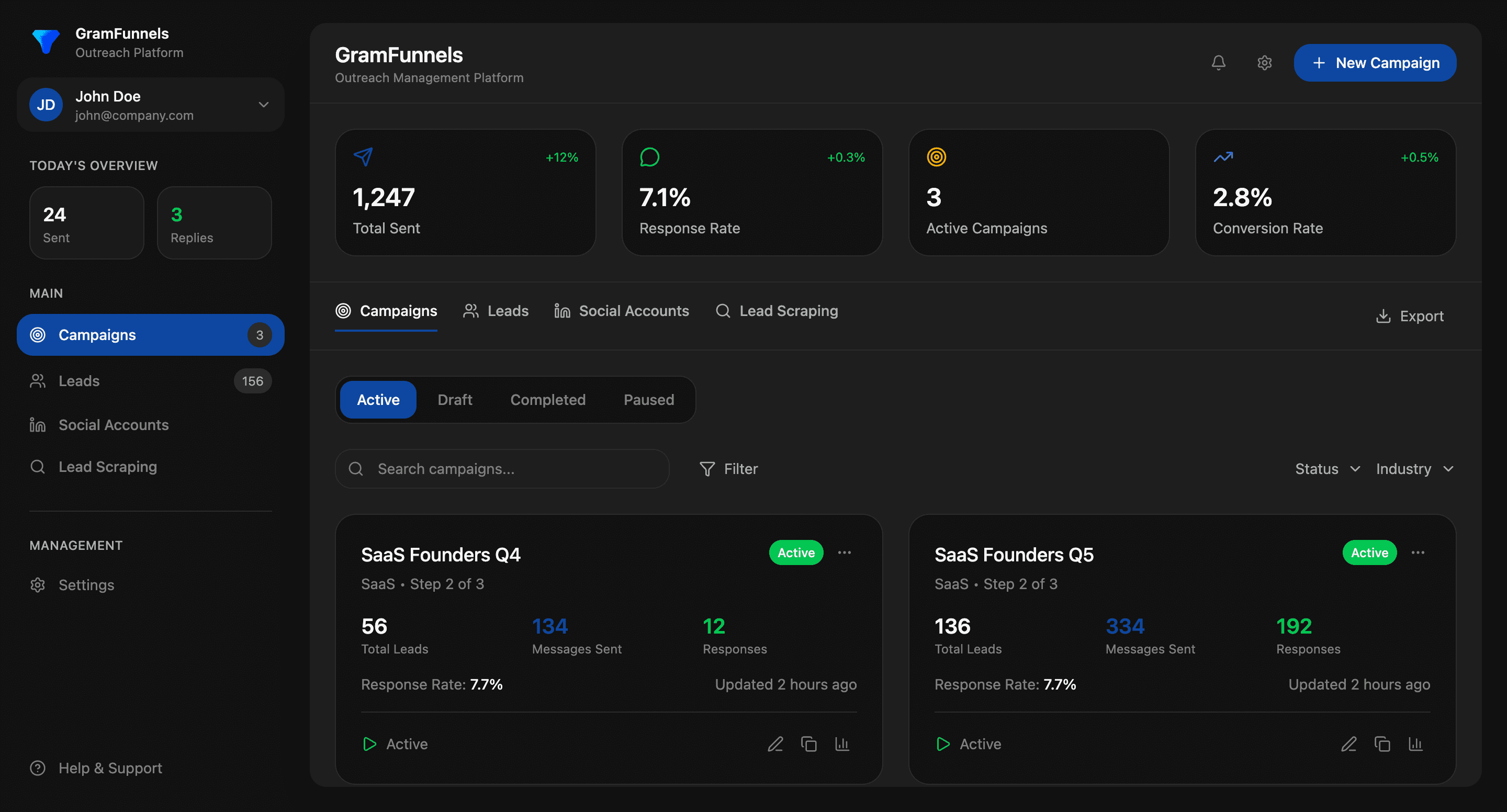
For companies specifically focused on LinkedIn outreach, GramFunnels takes this approach by mapping "demand surfaces" - identifying prospects based on 300+ intent signals showing active buying behavior. This allows businesses to run sophisticated LinkedIn outbound campaigns without needing API access or risking their personal LinkedIn accounts. The platform uses external infrastructure, ensuring brand safety while enabling AI-personalized messaging to high-intent prospects.
How to Decide If LinkedIn API Access Is Worth It
Determining whether to pursue LinkedIn API access requires honest evaluation of your business needs, budget, and alternative options. Consider these decision factors:
When LinkedIn API Makes Sense
Pursue API access if you:
- Are building a platform-level product with LinkedIn integration as a core feature
- Have budget for $100K+ annual costs plus ongoing infrastructure investment
- Need real-time, automated access to LinkedIn data at scale
- Can demonstrate clear value exchange in your partnership application
- Have 6-12 months to complete application, negotiation, and integration
- Require compliance-friendly, terms-of-service-compliant data access
When Alternatives Are Better
Consider alternatives if you:
- Are a small team or startup with limited budget
- Need LinkedIn data primarily for sales or recruiting, not product features
- Want to launch quickly (weeks, not months)
- Require features not available through the API
- Can achieve your goals through intent-based targeting rather than mass data access
- Are uncertain about long-term LinkedIn integration needs
For most businesses, especially those focused on high-intent LinkedIn targeting for sales purposes, alternative approaches provide faster time-to-value at dramatically lower costs.
The Future of LinkedIn API Access
LinkedIn continues tightening API access in response to privacy concerns, regulatory pressure, and platform integrity goals. Several trends are shaping the future landscape:
Increasing Restrictions
LinkedIn has progressively reduced API capabilities over the past five years:
- Elimination of certain Partner Program tiers
- Stricter application requirements and lower acceptance rates
- Reduced data fields available through approved endpoints
- More aggressive enforcement against terms violations
This trend will likely continue as privacy regulations expand and LinkedIn prioritizes user trust over partner ecosystem growth.
Focus on First-Party Relationships
LinkedIn is emphasizing tools that keep users on platform:
- Enhanced Sales Navigator features reducing need for external tools
- Improved CRM integration through LinkedIn's own connectors
- In-platform analytics and insights replacing third-party requirements
This strategy aims to capture more value directly rather than enabling partner ecosystems.
Rise of Privacy-First Alternatives
As direct data access becomes more restricted, successful solutions focus on:
- Public signal monitoring rather than private data extraction
- Intent inference from behavioral patterns
- First-party relationship building
- Permission-based data sharing
These approaches align with regulatory trends while still enabling effective business outcomes.
Conclusion
LinkedIn API pricing remains opaque by design, with costs ranging from $50,000 to millions annually depending on use case and data volume. For most businesses, especially those focused on sales and marketing rather than platform-level products, the combination of high costs, significant limitations, and lengthy implementation timelines makes direct API access impractical.
The good news is that effective LinkedIn strategies don't require API access. By focusing on intent signals, public engagement data, and strategic outreach, businesses can achieve their LinkedIn objectives at a fraction of the cost. Whether through Sales Navigator, third-party data providers, or intent-based platforms, alternatives exist that deliver results without the complexity and expense of API partnerships.
Before pursuing LinkedIn API access, carefully evaluate your actual requirements, timeline, and budget against available alternatives. For most use cases, you'll find that simpler, more affordable solutions deliver better outcomes with far less implementation complexity.