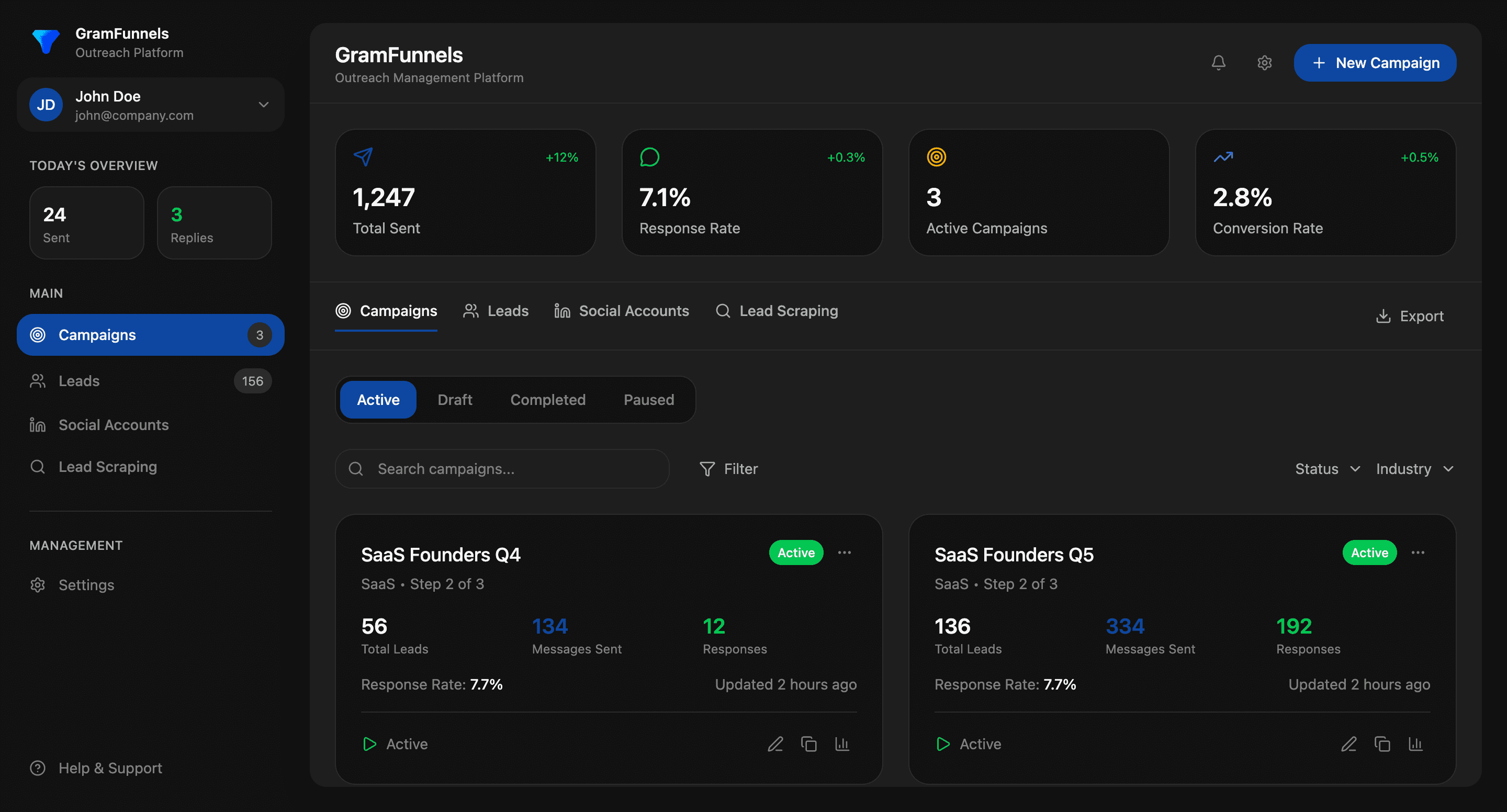
You've been running outreach campaigns for months. The numbers look impressive on the surface-thousands of messages sent, hundreds of profile visits, dozens of followers gained. But here's the uncomfortable truth: vanity metrics don't close deals.
The difference between a thriving outreach program and one that wastes time and resources comes down to one thing: measuring the right outreach metrics. Not just any metrics, but the ones that directly correlate with revenue, pipeline growth, and predictable sales success.
In this guide, we'll walk through the outreach metrics that actually matter, how to track them effectively, and how to use these insights to optimize your campaigns for maximum ROI.
Why Outreach Metrics Matter More Than You Think
Before we dive into specific numbers, let's establish why outreach metrics are non-negotiable for modern sales teams.
Most teams track activity metrics: "We sent 500 DMs this week!" Or vanity metrics: "We gained 2,000 followers!" These feel good in the moment, but they're disconnected from actual business outcomes.
According to research from HubSpot's State of Sales Report, sales teams that measure engagement quality (not just volume) are 50% more likely to hit their revenue targets. This shift from quantity to quality is transformative.
Outreach metrics bridge the gap between activity and results. They answer critical questions like:
- Is our messaging resonating with our target audience?
- Are we reaching the right people at the right time?
- Which outreach sequences are actually generating meetings?
- What's our true cost per qualified lead?
- Where are we losing prospects in the funnel?
Without clear outreach metrics, you're flying blind. You might optimize the wrong things or double down on ineffective tactics.
The Core Outreach Metrics Every Sales Team Needs to Track
Let's break down the essential outreach metrics that directly impact your bottom line.
1. Open Rate (or View Rate)
Definition: The percentage of outreach messages that are opened or viewed by recipients.
Why it matters: Open rate is your first checkpoint. If your open rate is low (below 15%), your subject lines, preview text, or timing might be off. If it's high (above 30%), your targeting and positioning are working.
Benchmark: For cold outreach on Twitter/X, typical open rates range from 20-40% depending on account authority and targeting precision.
How to optimize:
- Test different times of day (typically 9-11 AM is strong)
- Personalize subject lines with recipient names or company details
- Segment by audience-higher-value prospects may open at different rates than lower-tier ones
- Monitor account-level data to identify which accounts drive higher opens
2. Response Rate
Definition: The percentage of opened messages that receive a reply.
Why it matters: Response rate is where messaging quality becomes apparent. A 5-10% response rate on cold outreach is solid. Below 3% signals messaging problems-your value proposition isn't clear, or you're targeting the wrong people.
Benchmark: Effective outreach campaigns typically achieve 3-8% response rates. Top-performing campaigns with highly targeted audiences can reach 10-15%.
How to optimize:
- Lead with value, not a pitch-ask a question or provide a specific insight
- Keep messages short (under 100 words for maximum engagement)
- Reference specific details about the prospect's company or recent activity
- Use a clear call-to-action ("Should we chat?", "Worth a 15-minute call?")
- A/B test message variations to find what resonates
3. Conversion Rate (Meeting Rate)
Definition: The percentage of conversations that result in a booked meeting or qualified demo.
Why it matters: This is where revenue is made. A high response rate doesn't matter if those conversations don't convert. Typical B2B conversion rates range from 5-20% of responses, depending on offer fit and follow-up sequences.
Benchmark: If you're converting 10% of your responses into meetings, you're performing well. Below 5% suggests your follow-up sequences need work or your messaging is overpromising.
How to optimize:
- Implement multi-touch follow-up sequences (typically 3-5 touchpoints)
- Use our high-converting DM funnel guide to build structured sequences
- Personalize follow-ups based on prospect engagement signals
- Time follow-ups strategically-usually 2-3 days after initial message
4. Cost Per Outreach (or Cost Per Opportunity)
Definition: Total outreach program cost divided by the number of qualified opportunities generated.
Why it matters: This metric ties outreach directly to ROI. If your cost per opportunity is $50 and your average deal size is $50,000, your outreach is incredibly efficient. But if your cost per opportunity is $200 and your deal size is $10,000, you need to adjust your strategy.
How to calculate:
Cost Per Opportunity = (Total Program Cost) ÷ (Number of Meetings Booked)
How to optimize:
- Automate your outreach to reduce labor costs-this is where tools like GramFunnels excel by automating DM sequences at scale
- Improve targeting to reduce wasted outreach on unqualified prospects
- Focus on high-intent signals (recent posts, industry changes, job changes)
5. Lead Quality Score
Definition: A rating system (often 1-5) that assesses how likely a lead is to convert based on fit and engagement signals.
Why it matters: Not all meetings are equal. A meeting with a CEO at a 500-person company is more valuable than a meeting with a junior analyst. Lead quality metrics help your team prioritize follow-up efforts and focus on high-probability deals.
How to build a lead quality scoring system:
- Fit criteria: Company size, industry, location, use case match
- Engagement signals: Message opened, replied, clicked link, engaged with content
- Behavioral signals: Profile completeness, recent activity, industry relevance
6. Reply-to-Meeting Ratio
Definition: How many conversations you need to have before booking one meeting.
Why it matters: If your ratio is 4:1 (4 conversations = 1 meeting), that's solid. If it's 10:1, your follow-up strategy needs refinement. This metric helps you forecast pipeline more accurately.
Benchmark: A healthy reply-to-meeting ratio is between 3:1 and 8:1, depending on deal complexity and sales cycle.
Advanced Outreach Metrics for Scaling Teams
Once you've mastered the basics, these advanced metrics help teams operating at scale.
Pipeline Contribution Rate
This measures what percentage of your pipeline is sourced from outreach vs. other channels (inbound, referrals, paid ads). Companies using systematic outreach often see 40-60% of their pipeline coming from this channel when executed well.
Time-to-Conversion (Sales Cycle Length)
How long does it take from initial outreach to closed deal? B2B SaaS typically ranges from 30-90 days. If your outreach-sourced deals are closing significantly slower, investigate whether it's a messaging issue or a qualification issue.
Win Rate by Outreach Channel
Compare win rates across different outreach approaches-different audience segments, message variations, or platform strategies. This reveals which outreach mechanics are most effective for your business.
Churn Rate of Outreach-Sourced Customers
Do customers acquired through outreach have higher or lower churn rates than other channels? Some teams find that highly-targeted, personalized outreach leads to better customer fit and lower churn.
How to Track Outreach Metrics Effectively
Measuring metrics is only valuable if you have reliable systems in place.
Use CRM Integration
Connect your outreach platform directly to your CRM. This eliminates manual data entry and creates a single source of truth for all prospect interactions. If you're running X/Twitter outreach campaigns, tools with CRM integration capabilities will save your team hundreds of hours monthly while improving data accuracy.
Implement Automated Tracking
Manually tracking metrics is error-prone and time-consuming. Automated tracking through your outreach platform captures:
- When messages are sent and opened
- Response times and message content
- Meeting bookings and pipeline stage
- Deal outcomes
Create a Dashboard
Build a single dashboard that shows your key outreach metrics in real-time. Your dashboard should include:
- Weekly/monthly open rates
- Response rate trends
- Meetings booked vs. target
- Cost per opportunity
- Top-performing message templates
- Lead quality distribution
Review Metrics Weekly
Don't wait until the end of the month. Review metrics weekly to spot trends early and make rapid adjustments. A weekly review meeting (30 minutes) can help your team identify what's working and quickly iterate.
Turning Outreach Metrics into Action
Metrics are only useful if they drive decisions. Here's how to leverage outreach metrics for continuous improvement:
Identify Bottlenecks
If open rates are high but response rates are low, your messaging needs work. If response rates are good but conversion rates are poor, your follow-up sequences need optimization. Each metric tells a story about where to focus.
Test and Iterate
Use your metrics as guardrails for A/B testing. Change one variable at a time (subject line, message copy, send time) and measure the impact on your KPIs. Over time, these small improvements compound into significant gains.
Segment and Personalize
Track metrics by audience segment. Your metrics might look great overall, but you might discover that one audience segment has 2x the response rate. Double down on what's working.
Align with Sales Leadership
Share outreach metrics with your sales leadership regularly. Connect these metrics to pipeline and revenue impact. When leadership understands that your 6% response rate is generating 20% of pipeline, they'll support continued investment in the program.
Common Outreach Metrics Mistakes to Avoid
Mistake 1: Focusing on vanity metrics. High open rates don't guarantee revenue. Keep your eye on conversion, cost per opportunity, and pipeline contribution.
Mistake 2: Not accounting for seasonality. Your metrics will fluctuate based on time of year, industry events, and market conditions. Compare year-over-year or month-over-month within similar periods.
Mistake 3: Ignoring data quality. Garbage in, garbage out. If your CRM data is messy or your tracking is inconsistent, your metrics are meaningless. Invest in clean data.
Mistake 4: Setting unrealistic benchmarks. Don't compare your 50-person startup's metrics to a 500-person SaaS company's metrics. Develop benchmarks based on your own baseline and industry standards.
Mistake 5: Not accounting for list quality. A 3% response rate to a cold list is normal. A 3% response rate to highly-qualified prospects is concerning. Always contextualize your metrics by audience quality.
Building Your Outreach Metrics Framework
Start with these three steps:
Step 1: Establish a baseline. Run outreach for 2-4 weeks and measure your baseline open rate, response rate, and conversion rate. This becomes your starting point for improvement.
Step 2: Identify your key lever. Which metric has the biggest impact on revenue for your business? For most B2B teams, it's response rate or conversion rate. Focus on optimizing that first.
Step 3: Implement tracking and review cadence. Set up your CRM integration, build your dashboard, and schedule a weekly metrics review with your team.
Once this foundation is solid, layer in more sophisticated metrics as your program matures. For deeper insights on structuring your entire outreach system, check out our complete DM strategy guide which covers how to master X outreach metrics that drive real results.
If you're scaling outreach across multiple accounts or team members, you'll also want to learn how to manage team operations and scale X outreach programs while maintaining quality and compliance.
Conclusion: Metrics Drive Growth
Outreach metrics transform your campaign from a guessing game into a data-driven engine. When you measure the right KPIs-open rate, response rate, conversion rate, cost per opportunity, and lead quality-you gain visibility into exactly what's working and what needs improvement.
The teams winning at outreach aren't the ones sending the most messages. They're the ones measuring the most important metrics and iterating ruthlessly based on data.
Start this week: pick one metric to focus on, establish your baseline, and commit to weekly reviews. Small improvements in your response rate or conversion rate compound into major revenue impact over time.